You’ve seen the word. Maybe it showed up in a TikTok caption, or maybe Google’s autocomplete suggested it before you even finished typing. Either way, you’re here because you want a straight answer, not another vague article that dances around the point for ten paragraphs.
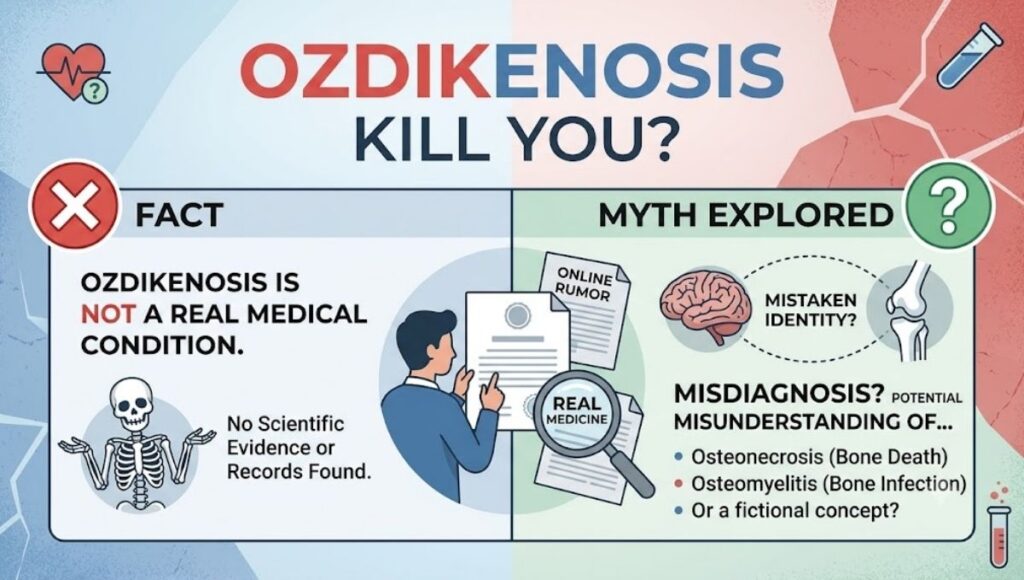
So here it is, right up front: Ozdikenosis is not a real, medically documented disease. There’s no hospital record of it, no peer-reviewed study describing it, and no doctor who trained on it in medical school. But that doesn’t make your question pointless. People don’t type “why does Ozdikenosis kill you” into a search bar for no reason. They type it because something scared them, and fear deserves a real explanation, not a shrug.
This guide gives you that explanation. We’ll cover where the term came from, why dozens of websites describe it in totally different ways, why the name tricks your brain into thinking it’s legitimate, and what you should actually do if you’re feeling unwell and searching for answers online.
What You’ll Learn in This Guide
- Whether Ozdikenosis is a real, recognized medical condition
- Where the term likely originated and why it spread so fast
- How different websites contradict each other about what it even is
- Why the name sounds medical even though it isn’t
- What real, fatal diseases actually require as proof
- How to fact-check any scary health term in under five minutes
- What to do if your symptoms are real, even if the disease name isn’t
Is Ozdikenosis a Real Disease? The Short Answer
No. There’s no entry for Ozdikenosis in the ICD-10 or ICD-11 classification systems that doctors worldwide use to code diagnoses. It doesn’t appear in PubMed’s index of medical research. No hospital network, university medical center, or public health agency has ever published anything about it. If a disease were real and dangerous enough to kill people, it would leave a paper trail: case studies, lab findings, at least one named researcher who identified it. Ozdikenosis has none of that.
What it does have is dozens of blog posts, many of them published within the last few months, all racing to answer the same search query. And that’s the real story here.
Where “Ozdikenosis” Actually Came From
Nobody can point to a “patient zero” for this condition, and that alone should tell you something. Real diseases get discovered because someone gets sick, a doctor investigates, and researchers eventually publish findings. Ozdikenosis skipped every one of those steps and went straight to search engines.
The Content-Farm Origin Story
The pattern looks a lot like something we’ve seen before with invented internet ailments. A vague, medical-sounding word starts circulating, often through a single seed article or a viral short-form video. Search interest ticks up because people are curious. Then content sites notice the rising search volume and rush to publish articles targeting that exact phrase, because ranking for a fast-growing, low-competition keyword is valuable traffic, whether or not the underlying topic is real.
The Timeline Problem
Look closely at when these articles were published, and you’ll notice something telling: most of them appeared within weeks of each other, not years apart. Real medical terminology accumulates slowly, through conferences, journals, and clinical practice. This term didn’t. It appeared everywhere almost at once, which is a signature of coordinated content production, not organic medical discovery.
The Contradiction Problem What Different Sites Claim It Is
Here’s the part that should really make you skeptical, and it’s the part most articles on this topic conveniently skip. If you read five different websites about Ozdikenosis, you’ll get five different diseases.
| Source Claim | What It Says Ozdikenosis Is |
|---|---|
| Site A | A lifestyle-driven “syndrome” caused by imbalance between metabolism, nervous system, and musculoskeletal function |
| Site B | A cellular condition that disrupts how cells produce and use energy, compared loosely to mitochondrial disease |
| Site C | A rare, possibly genetic condition involving abnormal tissue growths |
| Site D | A systemic disorder causing chronic neuromuscular inflammation |
| Site E | An unverified term with no medical basis at all, openly admitted in the article itself |
Real diseases don’t work this way. Lupus is lupus whether you read about it on the Mayo Clinic’s site or in a peer-reviewed journal. Multiple sclerosis doesn’t turn into a genetic tissue disorder on one website and a metabolic imbalance on another. When a “disease” changes its entire identity depending on which page you land on, that’s not medical nuance. That’s a sign nobody actually knows what it is, because it doesn’t exist.
Why the Name Sounds So Medically Convincing
Your brain isn’t being foolish for taking this seriously. The name is engineered, whether intentionally or through pattern imitation, to sound legitimate.
The “-osis” Suffix Trick
Think about real conditions you already know: fibrosis, tuberculosis, sclerosis, cirrhosis. The suffix “-osis” shows up constantly in actual medicine, usually referring to an abnormal condition or process. Your brain has learned to associate that sound with “serious medical thing,” so a made-up word wearing the same suffix slips past your skepticism.
Borrowed Credibility From Real Medical Language
Combine that suffix with a made-up root that sounds vaguely Greek or Latin, and you get something that reads like it belongs in a textbook, even though it was never in one. This is a known trick in misinformation generally: borrow the structure of credibility without any of the substance.
Why “Ozdikenosis Kill You?” Became a Search Trend
The exact question “does Ozdikenosis kill you?” spread for a very specific reason: it combines mystery with mortal stakes, which is one of the most clickable combinations in existence.
The Search-Intent Feedback Loop
Here’s how it plays out, step by step:
- Someone encounters a dramatic post or video mentioning the term
- They search it to learn more
- They find little to no reliable information, which increases anxiety rather than resolving it
- They search again, using slightly different phrasing
- Search engines notice rising interest in the term
- More content gets published to capture that traffic
- The cycle repeats, and the term looks more “real” simply because it’s everywhere
Content Farms Scaled It Fast
Dozens of near-identical articles cover this exact phrase, many published within the same few-month window, often with strikingly similar structure: an introduction admitting the term feels mysterious, a section explaining the “stages” of the supposed disease, a symptoms list, and a closing disclaimer. That kind of rapid, templated output is a hallmark of content built to capture search traffic rather than to document an actual medical discovery.
What Real, Documented Fatal Diseases Actually Look Like
It helps to know what legitimate proof actually looks like, so you can spot the difference next time.
A real fatal disease typically has:
- A named cause or mechanism (a pathogen, a genetic mutation, an organ failure process)
- Peer-reviewed research published in recognized medical journals
- An official classification code (ICD-10 or ICD-11)
- Documented case histories with lab results
- An established, even if imperfect, treatment protocol
- Recognition by major health bodies like the WHO, CDC, or national health ministries
Ozdikenosis checks none of these boxes. Not one.
As one health-literacy resource put it plainly: a name alone has never been evidence of a disease. Evidence comes from documentation, not from how scary or scientific a word sounds.
The Symptoms Being Attached to Ozdikenosis Are Real Just Not Proof of Ozdikenosis
Here’s where things get genuinely important, so pay attention to this part. The symptoms people associate with Ozdikenosis, like fatigue, brain fog, muscle aches, and unexplained soreness, are absolutely real experiences. The problem isn’t that these feelings are fake. The problem is that they’re being misattributed to a disease that doesn’t exist, when they actually overlap with several well-documented conditions:
| Symptom Often Linked to “Ozdikenosis” | Real Conditions That Actually Cause It |
|---|---|
| Persistent fatigue | Chronic fatigue syndrome, thyroid dysfunction, anemia, sleep disorders |
| Brain fog | Long COVID, depression, vitamin deficiencies, autoimmune conditions |
| Muscle aches and weakness | Fibromyalgia, mitochondrial disease, autoimmune myopathies |
| Unexplained soreness or stiffness | Inflammatory arthritis, lupus, chronic stress |
Symptom overlap is common in medicine. Dozens of legitimate conditions share overlapping symptoms with each other, which is exactly why doctors run tests instead of diagnosing from a checklist alone. A shared symptom list doesn’t confirm a new disease. It just means the human body has a limited number of ways to signal that something’s wrong.
Why This Kind of Misinformation Spreads Faster Than Corrections
Health misinformation has a structural advantage over accurate health information, and it comes down to incentives.
- Fear travels faster than reassurance. A scary headline earns more clicks than a calm, factual one, so algorithms end up amplifying alarm.
- Repetition creates false familiarity. The more often you encounter a claim, the more “true” it starts to feel, regardless of whether any evidence backs it up.
- Correction is boring by comparison. “This isn’t real” doesn’t spread nearly as fast as “this could kill you,” even when the first statement is the accurate one.
None of this means people searching the term are gullible. It means the information ecosystem is built to reward drama over accuracy, and it’s worth knowing that going in.
How to Fact-Check Any Viral Disease Claim in Under 5 Minutes
Next time a scary-sounding medical term crosses your feed, run it through this quick checklist before you panic:
- Search the term plus “ICD-10.” Real diagnoses have classification codes. If nothing comes up, that’s a red flag.
- Check PubMed. If a condition is real, at least some research will reference it, even if it’s rare.
- Check trusted health databases like MedlinePlus, the CDC, or the WHO’s disease directory.
- Look for a named source. Real diseases get identified by researchers or clinicians whose names show up in the history. A disease with no discoverer is a strong warning sign.
- Notice contradictions across sites. If five sources define the same “disease” five different ways, treat that as evidence against it, not for it.
If You’re Having Real Symptoms, Here’s What Actually Matters
If you’re reading this because you genuinely feel unwell, don’t let the fake name distract you from real care. Here’s what actually helps:
- Track your symptoms with dates, severity, and any patterns you notice, like time of day or after certain activities
- See a doctor and describe what you’re feeling in plain terms, without leading with an internet disease name
- Ask for basic bloodwork if fatigue, brain fog, or aches persist beyond a couple of weeks
- Seek urgent care immediately for chest pain, difficulty breathing, sudden severe weakness, or confusion, since these warrant emergency evaluation regardless of what you searched online
Your symptoms are valid even when the label you found for them isn’t.
The Bigger Pattern: Other Manufactured “Diseases” That Went Viral the Same Way
Ozdikenosis isn’t the first invented health term to spread this way, and it won’t be the last. The internet has repeatedly produced medical-sounding words that spread through curiosity and repetition rather than clinical discovery. The pattern is always the same: a dramatic claim appears, it borrows the structure of real medical language, search interest grows faster than fact-checking can keep up, and a wave of content arrives to meet that demand. Recognizing this pattern once makes it much easier to spot the next time it happens, and it will happen again under a different name.
FAQs
Is Ozdikenosis a real medical condition?
No. It doesn’t appear in any recognized medical classification system, and no verified clinical research documents it.
Why do so many websites describe it differently?
Because it isn’t a real, documented disease with a fixed definition. Each site is guessing or inventing details independently, which is why the descriptions contradict each other.
Why does the term sound so real?
It borrows the “-osis” suffix pattern common in legitimate medical terms, which triggers a false sense of familiarity and credibility.
Does Ozdikenosis kill you?
No, because Ozdikenosis itself has never been medically identified as an existing condition. The real danger lies in delaying care for actual symptoms while chasing an internet term instead.
What should I actually do if I feel unwell?
Track your symptoms, see a doctor, and get real bloodwork or testing done. Don’t let a fake disease name delay a real diagnosis.
How do I check if any disease name is legitimate?
Search for it alongside “ICD-10,” check PubMed and MedlinePlus, and look for named researchers or documented case studies. If none of that exists, treat the term with heavy skepticism.
Final Takeaway
Ozdikenosis isn’t a disease. It’s a case study in how quickly a scary-sounding word can spread online, gathering fear and traffic along the way while gathering zero actual evidence. The good news is that the tools to spot this pattern are simple: check for real documentation, watch for contradictions between sources, and never let a viral term replace an actual doctor’s visit. Your health deserves facts, not a name that was never real to begin with.