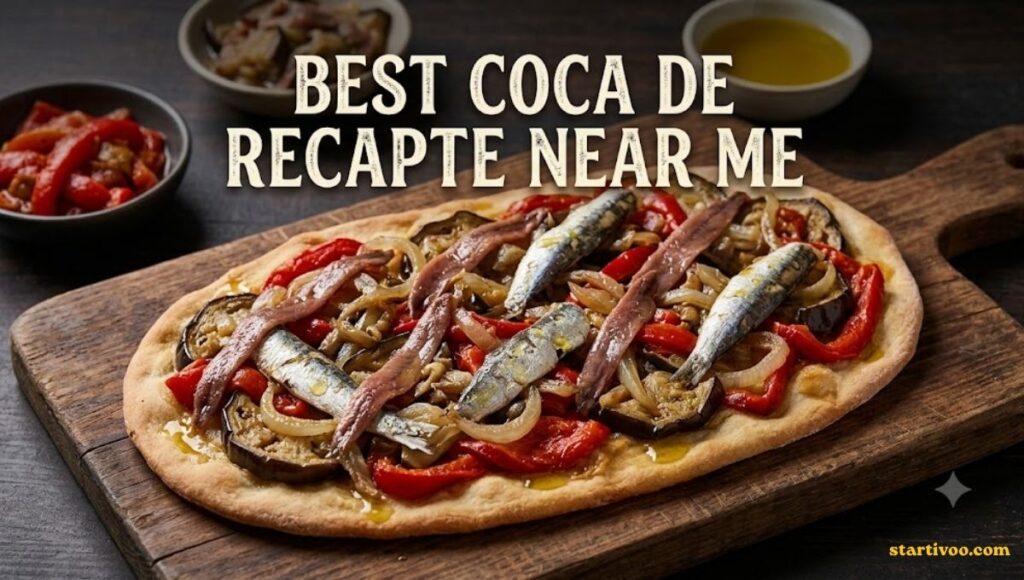
If you’ve ever wandered through Barcelona, Girona, or a small Catalan village and stumbled on a slab of savory flatbread piled high with roasted peppers and eggplant, you already know why this dish sticks with people. It’s not pizza. It’s not focaccia, either, though it shares DNA with both. It’s coca de recapte, and once you’ve had a good one, you start hunting for it everywhere you go. That’s exactly why so many people now search for the best coca de recapte near me the moment they land back in the States and realize their local pizzeria just isn’t going to cut it.
This guide breaks down what coca de recapte actually is, why it’s worth seeking out, and how to track down the real thing in the USA, without wasting time on flatbreads pretending to be something they’re not.
What Is Coca de Recapte?
Let’s start with the basics, because the name alone confuses a lot of people.
“Coca” comes from an old word tied to the same root as “cake” or the German “Kuchen.” <cite index=”3-1″>Its origin story traces back to using up leftover bread dough instead of throwing it away, with flattened dough scraps once topped with sugar and baked as a simple dessert.</cite> Over time, “coca” became the umbrella term for flatbreads and simple cakes eaten across a wide stretch of northeastern Spain.
“Recapte,” on the other hand, is Catalan for provisions, or roughly, “whatever you’ve got on hand.” <cite index=”6-1″>In Catalan, recapte identifies a topping made from what’s left in the kitchen, usually leaning heavy on vegetables.</cite> So coca de recapte, translated loosely, means “flatbread made from your garden haul.”
Put those two halves together and you get a rustic, olive-oil-based flatbread built on a thin dough base, topped with roasted vegetables and, often, something briny or smoky to round it out.
<cite index=”5-1″>The dish consists of a thin bread-dough base topped with roasted eggplants and peppers, known together as escalivada, along with tomatoes and onions.</cite> <cite index=”5-1″>The dough itself typically comes together from flour, salt, olive oil, yeast, sugar, and warm water.</cite>
Here’s a quick side-by-side that helps explain why people keep comparing it to pizza, and why that comparison falls short:
| Feature | Pizza | Coca de Recapte |
|---|---|---|
| Sauce | Tomato sauce base | No tomato sauce, olive oil instead |
| Cheese | Central to the dish | Rarely used, sometimes omitted entirely |
| Toppings | Endless, often heavy | Roasted vegetables, seasonal produce |
| Dough | Thicker, chewier | Thin, cracker-like or bread-like |
| Serving temp | Usually hot | Served hot, warm, or at room temperature |
| Origin | Naples, Italy | Catalonia, Spain |
<cite index=”6-1″>This kind of flatbread is similar to focaccia in Italy and fougasse in France</cite>, but coca de recapte carves out its own identity through its topping philosophy: use what’s fresh, keep it simple, and let the vegetables do the talking.
Why Americans Are Searching for “Coca de Recapte Near Me”
A few years ago, almost nobody outside Spanish food circles had heard of this dish. That’s changing, and fast, for a handful of reasons.
- Travel exposure. More Americans are visiting Barcelona and the Catalan countryside than ever, and coca de recapte shows up constantly at local bakeries, markets, and family tables.
- Regional Spanish food is having a moment. Tapas and paella already broke into the mainstream. Now curious eaters want the next layer: dishes that locals actually eat at home, not just tourist-menu staples.
- Overlap with foods people already love. If you’re into focaccia, flatbreads, or Mediterranean small plates, coca de recapte slots right in without feeling unfamiliar.
- Social media discovery. Short clips of Catalan bakers pulling coca out of a wood-fired oven rack up views, and viewers immediately want to know where they can try it themselves.
The catch? Actually finding it stateside takes more digging than finding, say, a decent slice of Neapolitan pizza. That’s the gap this guide is here to close.
What Makes Authentic Coca de Recapte Special
Not all flatbread topped with vegetables deserves the name. Authenticity here comes down to a handful of specifics.
First, the dough matters. A proper coca de recapte uses a thin, olive-oil-forward dough, closer to a rustic bread than a puffy pizza crust. <cite index=”2-1″>Coca is a popular flatbread in Catalonia, and coca de recapte specifically is savory, made with roasted eggplants, onions, peppers, tomatoes, salted cod, and sausages.</cite>
Second, technique counts. Traditionally, <cite index=”1-1″>Coca de Recapte was baked in Catalan towns at a time when peasants didn’t have ovens of their own, so they’d bring vegetables from their gardens to the local bakery, where the baker would use those vegetables to top the coques.</cite> That community-oven history is part of why the dish still feels rustic and personal rather than mass-produced.
Third, restraint separates the real thing from an imitation. Authentic coca de recapte doesn’t drown itself in cheese or sauce. The vegetables carry the flavor, and the olive oil does the rest. If a “coca” you’re eyeing looks like a loaded supreme pizza with a fancy name, that’s a red flag.
Traditional Toppings and Flavor Combinations
The heart of coca de recapte is escalivada, the classic Catalan combination of roasted eggplant, red pepper, and onion. From there, regional and family variations take over.
<cite index=”1-1″>In Catalonia, the most traditional version pairs escalivada with sardines, butifarra (Catalan sausage), onion, or spinach, and today you’ll find versions topped with almost anything, from mushrooms and tuna to olives and artichokes.</cite> <cite index=”2-1″>Salted cod and sausage are especially common additions layered on top of the roasted vegetables.</cite>
Common topping combinations you’ll run into:
- Classic escalivada – roasted eggplant, red pepper, onion, olive oil
- Sardine or anchovy coca – escalivada base with cured or fresh fish
- Butifarra sausage coca – Catalan sausage with caramelized onion
- Bacallà (salt cod) coca – salted cod flaked over roasted vegetables
- Mushroom and garlic coca – earthier, often served in cooler months
Worth noting: there’s a sweet cousin in this same family. <cite index=”2-1″>Coca de forner, or “baker’s coca,” is a sweet bread glazed with anise liqueur and eaten for breakfast or as a snack</cite>, and it shows up seasonally as Coca de Sant Joan around the feast of Saint John in June. If a menu lists “coca” without specifying, always ask which version you’re getting. You don’t want to order expecting escalivada and end up with dessert bread.
And Catalonia isn’t the only region with a version of this dish. <cite index=”6-1″>A similar flatbread called Coca de Trampò shows up in the Balearic Islands, particularly Mallorca, topped with a mix of onion, bell peppers, and tomatoes tossed with salt, pepper, and extra virgin olive oil.</cite> <cite index=”3-1″>Cocas in general are eaten throughout Catalonia, Aragon, Valencia, the Balearic Islands, and Andorra</cite>, so don’t be surprised if a bakery with roots in any of those regions has its own take.
Best Places in the USA to Find Coca de Recapte
Here’s the honest truth: coca de recapte is still a niche dish in America. There’s no national chain serving it, and Google Maps doesn’t have a dedicated category for it. Finding the best coca de recapte near me usually means thinking one layer broader than a direct search and knowing where to look.
Spanish and Catalan Bakeries
Your best shot is almost always a bakery, not a restaurant. Traditional Spanish and Catalan bakeries that make their own bread daily are the most likely to have coca on rotation, especially bakeries run by owners with roots specifically in Catalonia rather than generic “Spanish” branding. Since coca de recapte is fundamentally a bread-first dish, a shop that takes its dough seriously is going to nail it far more often than a restaurant treating it as a side item.
Artisan Mediterranean Cafés
Cafés leaning into broader Mediterranean or Iberian menus sometimes feature coca de recapte as a lunch special or a shareable starter. It won’t always be labeled by name, so keep an eye out for menu descriptions like “Catalan flatbread,” “roasted vegetable flatbread,” or “escalivada tart.” These cafés tend to rotate toppings seasonally, which actually lines up nicely with the original spirit of the dish.
Food Markets and Festivals
This is where you’ll often find the most authentic versions, ironically not in a restaurant at all. Spanish cultural centers, Catalan heritage associations, and European food festivals frequently bring in home bakers or visiting chefs who prepare coca the traditional way, over a proper hot oven, with seasonal produce. Keep an eye on:
- Local Spanish or Catalan cultural association event calendars
- Diada Nacional de Catalunya celebrations (Catalonia’s national day, September 11)
- Mediterranean or European food festivals in cities with strong immigrant communities
- Farmers markets with a Spanish or Mediterranean vendor stall
Local Hidden Gems
Some of the best coca de recapte in the country comes from small, family-run spots that don’t advertise it prominently, or don’t advertise much at all. These are the bakeries where a Catalan grandmother’s recipe gets passed down and made fresh a few times a week, sold quietly to a loyal local following. Reviews on Google and Yelp are genuinely useful here: search neighborhood Spanish bakery listings and scan the comments for words like “escalivada,” “Catalan,” or “coca” directly, since that’s often the only way these hidden spots surface.
How to Spot a High-Quality Catalan Bakery
Not every bakery selling Spanish food does coca de recapte justice. Here’s a quick checklist before you commit to a visit:
- Ask if the dough is made fresh in-house daily. A bakery that’s baking its own bread, not just reheating frozen dough, is a strong signal.
- Look for seasonal toppings. If the coca changes with what’s fresh, that’s true to the “recapte” concept. A menu that never changes is a warning sign.
- Check for escalivada specifically. If a bakery genuinely understands the dish, escalivada should be the backbone, not an afterthought.
- Read recent reviews closely. Look for specific mentions of texture (thin, crisp, not doughy) and flavor balance rather than generic praise.
- Ask the staff directly. A shop with real Catalan roots is usually happy to talk through the dish. If nobody can explain what makes their coca different from flatbread pizza, that tells you something.
Restaurant vs. Homemade Coca de Recapte
So which is better: hunting down a bakery, or making it yourself? Honestly, it depends on what you’re after.
Restaurant or bakery-made coca de recapte gives you:
- Proper technique and oven conditions you can’t easily replicate at home
- Consistency built from years of practice
- The chance to try a version you didn’t grow up with
Homemade coca de recapte gives you:
- Full control over toppings and dough hydration
- A far cheaper option if authentic bakeries aren’t nearby
- A genuinely fun weekend project, and a good excuse to use up whatever vegetables are sitting in your fridge
Here’s the practical reality for most readers outside a handful of major cities: authentic bakery versions simply aren’t around the corner yet. If that’s your situation, making it at home isn’t a consolation prize. It’s actually closer to the original spirit of the dish, since coca de recapte started as a way to use up whatever vegetables a family had on hand. <cite index=”6-1″>The dough for coca de recapte comes together with flour, water, olive oil, and yeast, and roasting eggplant, onion, and pepper for about half an hour before layering them on top gets you most of the way there.</cite> <cite index=”2-1″>Transferring the dough onto a pizza stone partway through baking helps crisp up the bottom.</cite>
What to Eat With Coca de Recapte
Coca de recapte works best as part of a spread rather than a standalone meal, which fits naturally with how Catalans actually eat it.
- Wine or cava – a crisp Catalan white or a glass of cava cuts nicely through the roasted vegetables and olive oil
- Cured meats and cheeses – jamón, manchego, or a simple charcuterie board rounds things out
- A light green salad – keeps the meal from feeling heavy
- Olives and pickled vegetables – classic tapas-style accompaniments that echo the coca’s own flavors
One baker who prepared coca at the Smithsonian Folklife Festival put it simply: <cite index=”2-1″>”I had never been applauded for my bread until the Folklife Festival.”</cite> That reaction says a lot about how coca lands with people trying it for the first time; it’s humble food, but it earns genuine enthusiasm once people taste it.
Why This Traditional Spanish Dish Is Growing in Popularity
A few forces are converging here, and none of them are going away anytime soon.
American food culture has spent the last decade moving away from generic “ethnic food” categories and toward specificity. People don’t just want “Spanish food” anymore; they want to know if something is Catalan, Basque, Andalusian, or Valencian, because each region cooks completely differently. Coca de recapte benefits directly from that shift.
There’s also a simple appetite factor. Compared to a cheese-loaded pizza, coca de recapte feels lighter and more vegetable-forward, which appeals to people looking for something satisfying that doesn’t sit like a brick afterward. And because it’s naturally vegetarian in its classic form, it fits neatly into a wider range of diets without anyone needing to modify the recipe.
Finally, there’s the discovery factor. Dishes like this spread through word of mouth and social sharing precisely because they feel like a find, not something you already knew about. Every person who tries coca de recapte for the first time and loves it becomes another person searching for the best coca de recapte near me, and that slow-building curiosity is exactly why this dish keeps showing up in more American cities, food festivals, and home kitchens each year.
Bottom line: coca de recapte isn’t hiding because it’s hard to make or hard to love. It’s hiding because it hasn’t had its “moment” in the US the way tapas or paella did years ago. If you track down a real Catalan bakery, a food festival with a Spanish vendor, or simply roast your own escalivada and build the dough from scratch, you’re tasting a dish with centuries of history behind it, born out of nothing more than peasants making the most of what they grew. That’s worth seeking out, wherever you happen to be searching from.