You’re scrolling through a fanfiction on Wattpad, or maybe just skimming a TikTok comment section, and there it is again: YN. No context, no explanation, just three letters sitting in the middle of a sentence like they’re supposed to make sense on their own.
Here’s the good news: they do make sense, once you know what to look for. YN meaning isn’t complicated, but it is one of those terms that changes shape depending on where you find it. Get the wrong definition in the wrong context, and a sentence that should feel personal and immersive ends up just confusing.
This guide breaks down exactly what does YN mean, where the term came from, how people actually use it today, and why search interest in it has climbed so much in 2026. No fluff, just the facts you came here for.
What Does YN Mean? (Quick Answer)
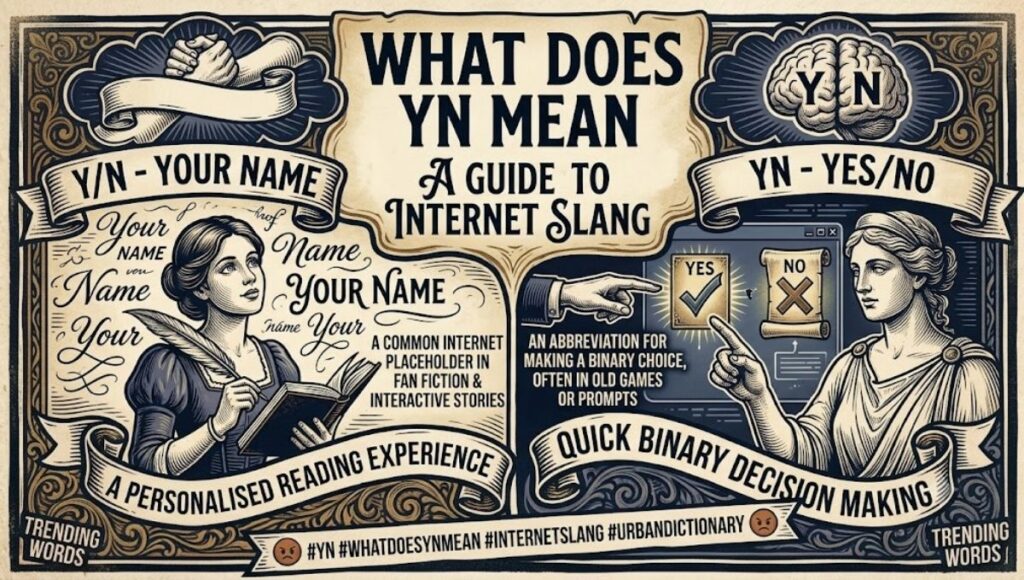
Short version first, since you probably don’t want to hunt for it: YN most commonly stands for “Your Name.” It works as a placeholder, most often in fanfiction and roleplay writing, so the reader can mentally swap it out for their own name and picture themselves as part of the story.
That said, YN carries a second, unrelated meaning too. In plain texting, forms, or quick decision-making conversations, YN stands for “Yes or No.” Someone might text “YN?” after a question, expecting a one-word reply.
So when someone asks what is a YN, the honest answer is: it depends entirely on where you saw it. Let’s dig into each meaning properly.
“Your Name” (Fanfiction & Reader-Insert Writing)
In fanfiction communities, particularly on Wattpad, AO3, and Tumblr, writers use Y/N (sometimes written without the slash as YN) as a stand-in for the reader’s actual name. A sentence like “YN walked into the room and froze” invites you, the reader, to insert yourself directly into the scene. You become the main character instead of just reading about one.
“Yes or No” (Texting & Quick Replies)
Outside of fandom spaces, YN often shows up as pure shorthand for a binary answer. Think of a friend texting “Coming tonight, YN?” It saves keystrokes and gets straight to the point, similar to how “IDK” replaces “I don’t know.”
Both meanings are common. Neither one is “more correct” than the other — the surrounding conversation tells you which one applies.
Where YN Actually Came From
The Y/N meaning most people associate with fanfiction has roots going back further than TikTok. Reader-insert stories existed long before short-form video did, and Tumblr helped popularize the format well before it went mainstream. Wattpad then took the concept and ran with it, especially within K-pop fandoms, anime communities, and celebrity fan fiction, where readers wanted to imagine themselves interacting with a favorite idol or character directly.
The “Yes or No” version developed on a completely separate track. It grew out of general internet and texting shorthand culture, the same lineage that gave us abbreviations like “TBH,” “NGL,” and “IDC.” There’s no dramatic origin story here; it’s simply efficient typing.
What’s interesting is that these two meanings never really merged. They just happen to share the same two letters, and only got confused with each other once “YN” spread beyond niche fandom spaces into everyday texting and mainstream social platforms.
Why YN Is Trending Hard in 2026
If YN has been around for over a decade, why does it feel like everyone’s suddenly asking about it right now? A few things are colliding at once.
- AI companion and chatbot apps have revived reader-insert formats. Interactive story apps and roleplay-style AI chats often use “YN” as a built-in variable name, exposing the term to people who’ve never touched a fanfiction site.
- TikTok’s POV and text-story trend format leans heavily on YN. Short clips styled like a scrolling text conversation, often built in CapCut, use “YN” constantly as a stand-in protagonist, and these videos rack up huge view counts.
- Gen Z content cycles resurrect older internet terms on a loop. Slang doesn’t disappear so much as go dormant, then resurface once a new platform or format brings it back into view.
- The two meanings actively colliding causes real confusion, which drives search volume on its own. People aren’t just curious; they’re genuinely trying to figure out which definition applies to a specific message they just received.
Put simply: reader-insert fiction never went away, and 2026’s short-form video culture just gave it a much bigger stage.
How YN Is Used in Real Conversations
Understanding a definition is one thing. Seeing it in action is what actually makes it click.
In texting and DMs, YN usually leans toward the “Yes or No” meaning, especially when it appears at the end of a question:
“Party’s at 9, YN?”
In social media captions and comments, either meaning can show up, though fanfiction-adjacent accounts almost always mean “Your Name”:
“YN really said ‘not today’ 😂”
In fanfiction and interactive storytelling, “Your Name” dominates completely:
“YN looked up, and for a second, everything else disappeared.”
In polls, surveys, or quick group chats, YN reverts back to “Yes or No” shorthand, functioning almost like a checkbox:
“Team dinner Friday — YN in the group chat, please.”
Context genuinely does all the heavy lifting here. Read the sentence around it, and the meaning usually becomes obvious within a few words.
YN vs. Similar Abbreviations
People frequently mix up YN with other short internet terms, so here’s a quick side-by-side to keep things straight.
| Term | Meaning | Typical Context |
|---|---|---|
| YN | “Your Name” or “Yes/No” | Fanfiction, texting, polls |
| Y/N | Same as YN, just styled with a slash | Fanfiction specifically |
| IDK | “I don’t know” | Texting |
| NGL | “Not gonna lie” | Texting, captions |
| TBH | “To be honest” | Texting, comments |
| OC | “Original character” | Fanfiction, roleplay |
| POV | “Point of view” | TikTok, fanfiction, video captions |
Notice that YN and Y/N mean exactly the same thing. The slash is purely stylistic, a formatting choice writers use to make the placeholder more visually obvious on the page.
Common Mistakes People Make With YN
Even people who’ve seen the term dozens of times still trip over a few recurring misunderstandings.
Mistake 1: Assuming YN always means “Your Name.” It doesn’t. If someone’s texting you casually and asks “YN?” after a plan, they almost certainly want a yes-or-no answer, not your literal name.
Mistake 2: Using YN in formal or professional writing. This one’s a hard no. YN is internet slang through and through, and it has no place in an email to a client, a resume, or a work Slack message. Save it for casual chats and social captions.
Mistake 3: Confusing YN with lookalike abbreviations. Terms like “OC” and “POV” often appear in the same sentences as YN, especially in fanfiction, but they mean entirely different things. Mixing them up muddles the whole sentence.
How to Respond When Someone Sends You “YN”
Not sure how to reply? Here’s how it typically plays out.
Casual texting context:
Them: “Coming out tonight, YN?” You: “YN!!” (meaning “yes”) or simply “N” for no.
Fanfiction or roleplay context:
Story: “YN smiled and said nothing.” You: Just keep reading — mentally, you’re the one smiling.
When the meaning genuinely isn’t clear:
“Wait, do you mean yes/no or is this a fanfiction thing? 😅”
There’s no shame in asking for clarification. Even people who use the term constantly sometimes get tripped up by which version someone means.
YN in Dating Apps and Flirty Texting
YN has also worked its way into dating app conversations, particularly on apps like Hinge and Bumble, where quick, low-effort exchanges are the norm. A message like “You seem cool, YN?” reads as playful and low-pressure, letting someone gauge interest without committing to a full sentence. The tone tends to land as casual and a little flirty rather than lazy, though that really depends on who’s reading it. Some people appreciate the brevity; others find it a bit too vague for a first impression.
Popularity and Staying Power
Slang terms usually fade fast, but YN has held on for well over a decade specifically because it fills two genuinely useful roles at once: it’s efficient shorthand for a real question, and it’s a storytelling device that makes readers feel involved rather than just informed. That combination gives it staying power that a lot of trendier, single-purpose slang never gets.
FAQs
What does YN mean in texting?
In everyday texting, YN almost always means “Yes or No,” usually tacked onto the end of a quick question.
What does YN mean in fanfiction?
Within fanfiction and reader-insert stories, YN stands for “Your Name,” letting the reader picture themselves as the story’s main character.
Is YN formal or informal?
Strictly informal. It belongs in texts, captions, and casual chats, not in professional or academic writing.
Can YN have more than one meaning?
Yes, and that’s exactly why it causes confusion. The two dominant meanings, “Your Name” and “Yes or No,” are unrelated, so context is everything.
Should I use YN in professional messages?
No. Stick to full words in work emails, client messages, or anything formal. YN reads as casual internet shorthand, and it can come across as unprofessional in the wrong setting.
Key Takeaways
- YN meaning splits into two main definitions: “Your Name” (fanfiction) and “Yes or No” (texting).
- Context, not the letters themselves, determines which meaning applies.
- The fanfiction usage traces back to Tumblr and Wattpad reader-insert culture.
- 2026’s search spike ties directly to AI roleplay apps and TikTok’s text-story video trend.
- Never use YN in formal or professional writing, no matter which meaning you intend.
Conclusion
So, what does YN stand for, really? It depends entirely on where you spotted it. Catch it in a fanfiction or a POV-style TikTok, and it’s almost certainly “Your Name.” Catch it at the end of a casual text, and it’s shorthand for “Yes or No.” Once you know both meanings exist side by side, the confusion mostly disappears, and you can read the context clues like anyone fluent in internet slang already does.