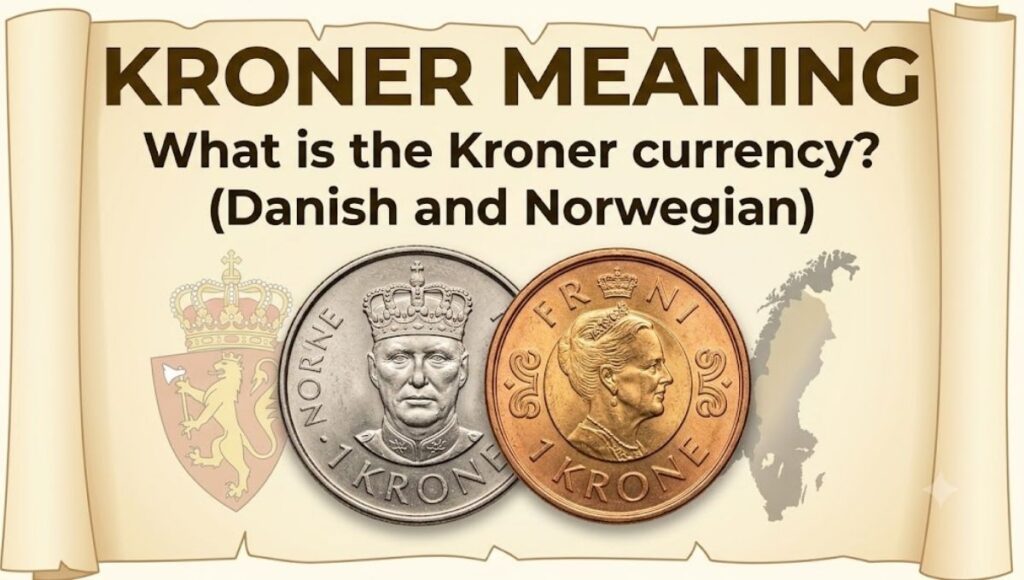
If you’ve ever traveled to Scandinavia, traded currencies, or read international financial news, you’ve probably come across the word kroner. At first glance, it may seem like the name of a single currency. In reality, the term refers to several national currencies used across Northern Europe.
Understanding kroner meaning goes beyond knowing its translation. It helps you understand why Nordic countries have their own currencies, how these currencies differ, and why they continue to play an important role in global finance.
In this guide, you’ll learn what kroner mean, which countries use it, its historical origins, exchange rates, banking uses, and much more.
What Does Kroner Mean?
The word kroner is the plural form of “krone,” a currency unit used in several Scandinavian countries. In English, krone literally translates to “crown.”
When people ask what does kroner mean, they usually want to know whether it refers to one currency or several. The answer is simple:
- Krone = one unit of currency
- Kroner = multiple units of currency
For example:
- 1 Danish krone
- 100 Danish kroner
Although several countries use currencies called krone or krona, each nation issues and manages its own independent currency.
Quick Fact: The name “krone” comes from the Latin word corona, meaning crown, symbolizing royal authority.
What Does “Kroner” Mean in English?
In English, kroner simply means crowns, referring to units of Scandinavian currency.
Unlike currencies such as the U.S. dollar, British pound, or Japanese yen, kroner is not a single international currency. Instead, it’s a shared name used by multiple Nordic countries.
Is Kroner a Currency or Just a Word?
It’s both.
- Kroner is the plural noun describing currency units.
- Krone is the official currency name in Denmark and Norway.
- Sweden uses krona instead of krone because of language differences.
- Iceland uses króna, which includes an accented letter.
Why Is It Called Kroner?
The name dates back centuries when European monarchies placed crowns on coins to represent royal power.
The word evolved as follows:
| Language | Meaning |
|---|---|
| Latin | Corona (Crown) |
| Danish | Krone |
| Norwegian | Krone |
| Swedish | Krona |
| Icelandic | Króna |
Even today, the currency name continues that historical tradition.
The Meaning of “Crown” in European Currency
Many European currencies once used names related to crowns because monarchies ruled much of Europe.
Examples include:
- Czech Koruna
- Danish Krone
- Norwegian Krone
- Swedish Krona
- Icelandic Króna
Although these currencies share similar names, they are completely separate monetary systems.
Singular vs. Plural: Krone and Kroner
| Form | Example |
|---|---|
| Krone | 1 krone |
| Kroner | 25 kroner |
Swedish grammar differs slightly:
- 1 krona
- 10 kronor
Which Countries Use Kroner?
Today, four countries use currencies based on the krone or krona.
| Country | Currency | ISO Code | Symbol |
|---|---|---|---|
| Denmark | Danish Krone | DKK | kr |
| Norway | Norwegian Krone | NOK | kr |
| Sweden | Swedish Krona | SEK | kr |
| Iceland | Icelandic Króna | ISK | kr |
Although the names look alike, each currency has its own exchange rate, central bank, and monetary policy.
Denmark (Danish Krone – DKK)
The Danish krone has been Denmark’s official currency since 1875.
Interesting facts:
- Currency code: DKK
- Managed by Danmarks Nationalbank
- Closely tied to the euro through the ERM II exchange-rate mechanism
- Denmark is part of the European Union but has opted to keep its own currency.
Norway (Norwegian Krone – NOK)
The Norwegian krone is one of Europe’s strongest currencies because Norway has a stable economy and significant oil and gas exports.
Key facts:
- Currency code: NOK
- Issued by Norges Bank
- Oil prices often influence its value.
- Frequently traded in global forex markets.
Sweden (Swedish Krona – SEK)
Sweden uses the Swedish krona, not the euro.
Highlights include:
- Currency code: SEK
- Managed by Sveriges Riksbank, one of the world’s oldest central banks
- Sweden is one of the most cashless societies globally, with digital payments dominating everyday transactions.
Iceland (Icelandic Króna – ISK)
Iceland continues using its own currency despite its close ties with Europe.
Key facts:
- Currency code: ISK
- Issued by the Central Bank of Iceland
- Supports Iceland’s independent monetary policy
- Recovered significantly after the country’s 2008 financial crisis.
Are Krone, Kroner, and Krona the Same?
This question causes confusion for many travelers.
Here’s a simple comparison.
| Term | Meaning |
|---|---|
| Krone | Singular currency unit |
| Kroner | Plural form of krone |
| Krona | Swedish singular form |
| Kronor | Swedish plural form |
The currencies are similar in name but belong to different countries.
History of the Kroner Currency
The history of kroner stretches back more than a century.
Origins in Scandinavian Monarchies
Before modern banking systems developed, Scandinavian kingdoms issued coins bearing royal crowns. Those symbols inspired the currency name still used today.
The Scandinavian Monetary Union
In 1873, Denmark and Sweden formed the Scandinavian Monetary Union, with Norway joining in 1875.
The union:
- Introduced currencies with equal value.
- Based exchange rates on the gold standard.
- Allowed currencies to circulate freely among member countries.
The union ended after World War I when countries adopted independent monetary policies.
Leaving the Gold Standard
Like many nations, Scandinavian countries eventually abandoned the gold standard. Their currencies began floating according to market forces rather than fixed gold reserves.
What Does the “kr” Symbol Mean?
Every Scandinavian kroner currency uses the abbreviation:
kr
You’ll commonly see prices displayed like:
- kr 120
- 450 kr
Unlike the dollar sign ($), kr appears either before or after the amount depending on local conventions.
Currency Codes Explained
International banking relies on ISO currency codes.
| Currency | Code |
|---|---|
| Danish Krone | DKK |
| Norwegian Krone | NOK |
| Swedish Krona | SEK |
| Icelandic Króna | ISK |
These codes prevent confusion because several currencies share the “kr” symbol.
How Much Is Kroner Worth?
There isn’t one universal value for kroner because each country’s currency trades independently.
The value changes constantly based on:
- Interest rates
- Inflation
- Supply and demand
- Global economic conditions
- Central bank decisions
For current exchange rates, check trusted financial websites such as:
- https://www.xe.com
- https://www.oanda.com
- https://www.investing.com
Kroner to USD Explained
Currency conversion is straightforward.
Example:
If:
- 1 USD equals a certain amount of Norwegian kroner today
Then:
- 100 USD equals that exchange rate multiplied by 100.
Since exchange rates fluctuate throughout the day, always use a live converter before exchanging money.
What Determines the Value of Kroner?
Several economic forces influence Scandinavian currencies.
Interest Rates
Higher interest rates often attract foreign investment, increasing demand for the currency.
Inflation
Low inflation usually helps preserve purchasing power.
Oil Prices
Norway’s economy depends heavily on petroleum exports. Rising oil prices often strengthen the Norwegian krone.
Economic Growth
Healthy employment, production, and consumer spending generally support currency stability.
Central Bank Policies
Each central bank adjusts monetary policy to maintain economic stability.
Why Nordic Countries Still Use Kroner Instead of the Euro
Many travelers assume every European country uses euros.
That isn’t true.
Reasons include:
- Norway and Iceland are not members of the European Union.
- Denmark negotiated an opt-out from adopting the euro.
- Sweden has repeatedly chosen to keep the krona following a national referendum and subsequent policy decisions.
Maintaining independent currencies allows these countries to control:
- Interest rates
- Inflation
- Exchange rates
- Monetary policy
Kroner in Banking and International Payments
Banks use kroner every day for:
- International transfers
- Business payments
- Import and export transactions
- Foreign exchange services
Businesses trading with Scandinavian countries often invoice customers in local currency to reduce exchange-rate uncertainty.
Kroner in Forex Trading
Scandinavian currencies attract many professional traders.
Popular currency pairs include:
- USD/NOK
- EUR/NOK
- EUR/SEK
- USD/SEK
- EUR/DKK
Forex traders monitor:
- Central bank announcements
- Inflation reports
- GDP growth
- Oil prices
- Interest-rate decisions
Central Banks Behind Kroner Currencies
| Country | Central Bank |
|---|---|
| Denmark | Danmarks Nationalbank |
| Norway | Norges Bank |
| Sweden | Sveriges Riksbank |
| Iceland | Central Bank of Iceland |
These institutions manage inflation, oversee financial stability, and influence exchange rates through monetary policy.
How Kroner Is Used in Everyday Life
Residents use kroner for nearly every transaction.
Examples include:
- Grocery shopping
- Utility bills
- Rent payments
- Public transportation
- Dining
- Online purchases
Most stores also accept contactless cards and mobile wallets.
Cash vs. Digital Payments in Scandinavia
Scandinavia leads the world in digital payments.
Common payment methods include:
- Contactless credit cards
- Apple Pay
- Google Pay
- Mobile payment apps
- Bank transfers
Cash remains available but is becoming less common, especially in Sweden.
Case Study: Many Swedish businesses, museums, and cafés now operate as cash-free establishments, accepting only digital payments to improve efficiency and security.
Kroner and Tourism
Visitors should know a few essentials before traveling.
Travel tips:
- Credit cards are widely accepted.
- Currency exchange at airports may offer less favorable rates.
- Local ATMs often provide competitive exchange rates.
- Notify your bank before international travel.
Kroner in International Trade
Scandinavian countries export products worldwide.
Major industries include:
- Energy
- Shipping
- Pharmaceuticals
- Renewable technology
- Timber
- Seafood
- Manufacturing
Stable currencies make international trade more predictable.
Scandinavian Economies Behind the Kroner
Each Nordic economy has unique strengths.
| Country | Economic Strength |
|---|---|
| Denmark | Pharmaceuticals, shipping, renewable energy |
| Norway | Oil, gas, seafood |
| Sweden | Manufacturing, technology, automotive |
| Iceland | Tourism, fishing, renewable energy |
These diversified economies contribute to the long-term credibility of their currencies.
Common Myths About Kroner
Many misconceptions continue to circulate.
Myth: Kroner is one single currency.
Fact: Four countries issue their own separate currencies.
Myth: Sweden uses the euro.
Fact: Sweden continues using the Swedish krona.
Myth: Krone and kroner are different currencies.
Fact: They’re simply singular and plural forms of the same word.
Interesting Facts About Kroner
- Krone literally means “crown.”
- Norway’s sovereign wealth fund is the world’s largest, with assets valued at over $1.8 trillion in recent years.
- Sweden ranks among the world’s leaders in cashless payments.
- Denmark keeps the krone closely linked to the euro through a fixed exchange-rate policy.
- Iceland maintained its independent currency despite significant financial challenges during the global financial crisis.
Quick Comparison of Scandinavian Currencies
| Feature | Denmark | Norway | Sweden | Iceland |
|---|---|---|---|---|
| Currency | Krone | Krone | Krona | Króna |
| Code | DKK | NOK | SEK | ISK |
| Symbol | kr | kr | kr | kr |
| Euro Used | No | No | No | No |
Pronunciation of Kroner
In English, kroner is commonly pronounced:
KROH-ner
Local pronunciations vary slightly depending on the country’s language.
Kroner Meaning in Other Languages
Urdu
کرونر سے مراد اسکینڈے نیوین ممالک کی کرنسی کی اکائی ہے، جس کا مطلب “تاج” یا “کراؤن” ہوتا ہے۔
Hindi
क्रोनर का अर्थ स्कैंडिनेवियाई देशों की मुद्रा की इकाई है, जिसका शाब्दिक अर्थ “मुकुट” (Crown) होता है।
Frequently Asked Questions
What does kroner mean?
Kroner is the plural form of krone, the currency unit used in Denmark and Norway. The term also broadly refers to Scandinavian currencies with similar names.
Is kroner a real currency?
Yes. It refers to legitimate national currencies issued by Denmark, Norway, Sweden, and Iceland.
Which countries use kroner?
Denmark, Norway, Sweden, and Iceland all use currencies named krone, krona, or króna.
What is the difference between krone and kroner?
Krone is singular, while kroner is plural.
Is krona the same as kroner?
Not exactly. Krona is the Swedish singular form, while kroner is the Danish and Norwegian plural form.
What does “kr” stand for?
kr is the standard abbreviation used for Scandinavian currencies.
Why doesn’t Sweden use the euro?
Sweden has chosen to retain the Swedish krona and maintains its own independent monetary policy.
Which kroner currency is strongest?
Strength varies over time because exchange rates fluctuate daily. There is no permanently strongest Scandinavian currency.
What are DKK, NOK, SEK, and ISK?
These are the official ISO currency codes for the Danish krone, Norwegian krone, Swedish krona, and Icelandic króna.
Can you use euros in Scandinavian countries?
Some tourist businesses may accept euros, but local currencies remain the official legal tender.
Is kroner accepted outside Scandinavia?
Generally, kroner is exchanged through banks and currency exchange services rather than used directly outside its home country.
How do I convert kroner into U.S. dollars?
Use a reputable live exchange-rate service or your bank to convert kroner into U.S. dollars based on the current market rate.
Final Thoughts
Understanding kroner meaning becomes much easier once you realize it isn’t a single currency. Instead, it represents a family of closely related Scandinavian currencies that share a common historical origin but operate independently today.
Whether you’re planning a trip to Northern Europe, studying economics, following global markets, or simply curious about what kroner mean, knowing the differences between DKK, NOK, SEK, and ISK gives you a clearer understanding of how Scandinavian financial systems work. Despite their shared heritage and the common “kr” symbol, each currency reflects the unique economy, policies, and history of the country that issues it.