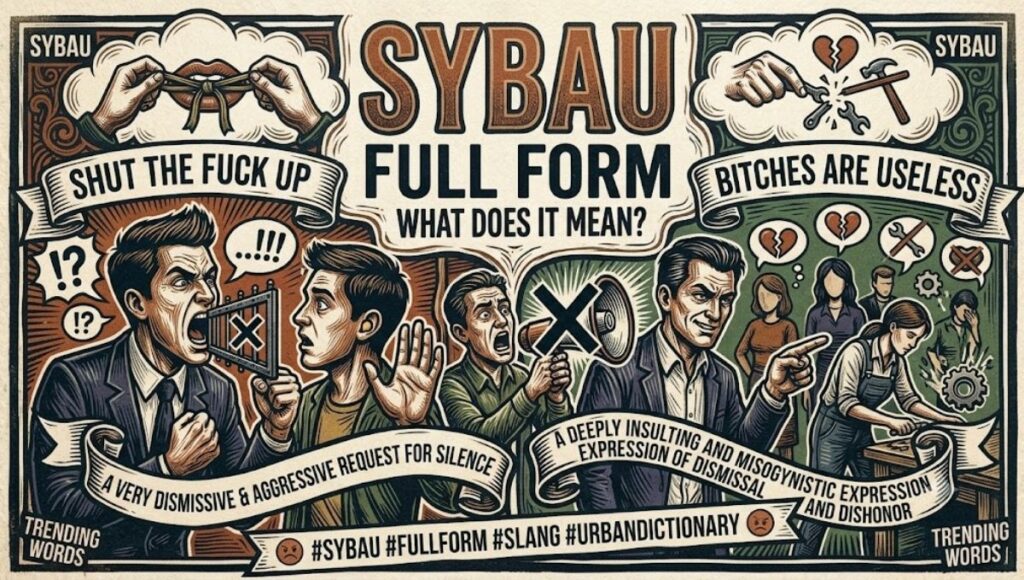
You’ve seen it in a TikTok comment section. Maybe a friend dropped it in a group chat and you had no idea whether to laugh or feel insulted. That’s the thing about SYBAU meaning it looks harmless until you look up the full form, and then it suddenly makes a lot more sense why the room went quiet.
This guide breaks down what does SYBAU mean, where it came from, how people actually use it on TikTok, Snapchat, Instagram, and Discord, and how to respond if someone throws it at you. No fluff, no guessing just the real story behind one of the most recognizable pieces of internet slang right now.
What Does SYBAU Mean?
Let’s get the sybau meaning full form out of the way first, since that’s probably why you’re here.
SYBAU stands for “Shut Your Bitch Ass Up.”
It’s blunt. It’s rude. And it’s meant to shut a conversation down, fast. The SYBAU acronym works exactly like GTFO or STFU you take a phrase that would sound harsh spelled out, compress it into four letters, and suddenly it’s easier to type, easier to read, and somehow easier to say without feeling like you’re actually cursing someone out.
The Full Form, Spelled Out
Here’s the sybau full form broken into its parts, so the meaning of sybau is crystal clear:
| Letter | Stands For |
|---|---|
| S | Shut |
| Y | Your |
| B | Bitch |
| A | Ass |
| U | Up |
Put together, it reads as a command: stop talking, right now. That’s the core of the SYBAU definition, no matter which platform you see it on.
Quick Examples
Here’s SYBAU meaning in text in action, the way you’d actually see it used:
- “bro said the earth is flat again… sybau 💀”
- “SYBAU nobody asked”
- “me: shares hot take / friend: SYBAU 😭”
Notice something? None of these read as genuinely hostile. That’s because SYBAU meaning in chat depends almost entirely on who’s saying it and why more on that below.
How Harsh It Actually Is
Spelled out, the phrase is genuinely vulgar. Shut Your B*tch Ass Up contains a curse word and an aggressive tone that would raise eyebrows if someone said it out loud to a stranger. But abbreviated into four letters, it loses a chunk of its bite. That’s actually the whole point, and it’s a pattern you’ll see across most texting abbreviations compress the insult, keep the punch, lose some of the shock value.
Where SYBAU Actually Came From
Most articles claiming to explain SYBAU explained skip this part or get it wrong. Here’s the real timeline, based on documented usage.
The 2003 Urban Dictionary Roots
This one might surprise you: SYBAU is not new. The term was first defined on Urban Dictionary back on November 19, 2003, with the same meaning it has today. So while it feels like a 2025 invention, it’s actually old enough to vote.
Why It Went Dormant, Then Came Back
For close to two decades, SYBAU stayed mostly buried in niche forums and early internet chatrooms. It didn’t have the infrastructure to spread no TikTok, no algorithm-driven comment sections, no meme remix culture to push it into the mainstream. It just sat there, waiting.
The 2021–2022 Discord and Gaming Comeback
Around 2021, gaming chat slang started reviving the term. Gamers needed short, sharp comebacks during heated matches, and Discord slang communities picked SYBAU back up as a quick way to shut down trash talk without breaking flow. It spread through gaming voice chats and text channels before ever hitting a wider audience.
How TikTok Turned It Mainstream
By 2024, TikTok slang absorbed SYBAU into its comment culture. Creators started dropping it under videos with controversial takes, and it exploded further in 2025 thanks to unrelated cultural moments Love Island USA discourse being a big one, where fans used it to react to spoilers and messy contestant behavior. Merriam-Webster even picked it up in its slang dictionary, describing it plainly as “an angrier way to say ‘shut up’ online.”
Why SYBAU Blew Up When Most Slang Fades Fast
Not every acronym survives past a few weeks. SYBAU had a few things working in its favor.
It dodges content moderation filters. Platforms flag explicit profanity more aggressively than acronyms. Typing “SYBAU” slides past filters that would catch the spelled-out version, which makes it a handy workaround for anyone posting online slang terms that platforms might otherwise flag or shadowban.
It’s genuinely fun to type and say. Try saying it out loud “sigh-bow.” It has a rhythm to it that STFU just doesn’t.
It thrives in meme remix culture. You’ll often see it stacked with other social media acronyms, like “TS PMO ICL SYBAU” (translation: “this stuff pisses me off, I can’t lie, shut your bitch ass up”). Combos like these are part of a broader trend of slang overload memes designed to look chaotic and confusing to anyone outside the loop which, ironically, is exactly what makes them shareable.
How People Actually Use SYBAU
Context changes everything with this term. Here’s how how to use SYBAU breaks down across real situations.
- Between friends: Almost always banter. Think of it as digital eye-rolling a way to tease someone without actual malice.
- Gaming chats and Discord: A quick comeback during matches, usually thrown around after a bad play or a smug comment.
- TikTok and Twitter comment sections: A reaction to a hot take, a bad opinion, or spoiler-dropping very common in fandom spaces.
- Genuine arguments: Occasionally used with real hostility, especially between strangers or during actual conflict.
“Sybau, I’m here for recipes.” a BlueSky user reacting to unrelated drama in a cooking post’s comments, October 2025.
That quote captures the tone most people actually use it with: playful annoyance, not real anger.
The One Rule That Decides Tone
Here’s the honest answer to what does SYBAU mean in any given comment: it means whatever the relationship between the two people makes it mean. Same four letters, wildly different weight, depending on whether it’s your best friend joking around or a stranger trying to start something.
SYBAU Across Platforms What Changes
SYBAU meaning on TikTok leans playful most of the time it’s comment-section banter, often paired with a skull emoji or laughing reaction. SYBAU meaning on Instagram works similarly, showing up in comments and occasionally DMs. SYBAU meaning on Snapchat, since conversations there tend to be more private and one-on-one, skews slightly more likely to carry real irritation behind it. On WhatsApp group chats, it usually shows up as a joking response to an annoying message thread.
| Platform | Common Tone | Typical Setting |
|---|---|---|
| TikTok | Playful, joking | Comment sections, reaction videos |
| Twitter/X | Sarcastic, sharp | Quote-tweets, fandom discourse |
| Playful | Comments, DMs | |
| Snapchat | Mixed, sometimes serious | Private chats |
| Joking | Group chats | |
| Discord | Competitive banter | Gaming voice/text chats |
Common Misconceptions About SYBAU
A few myths keep circulating, so let’s clear them up.
- “It’s always meant seriously.” Not true. Most usage today is joking, especially among friends and in meme captions.
- “It’s safe to say to strangers.” Also not true. Without an existing relationship, it reads as genuinely rude.
- “It has a wholesome backronym.” You’ll sometimes see joke reinterpretations like “So You Better Act Up.” These are internet humor, not the actual origin the real SYBAU acronym has always meant the same vulgar phrase since 2003.
- “It’s fine at work or school.” It isn’t. Save it for casual online conversations, not professional ones.
SYBAU vs. Similar Slang
Comparing SYBAU to its slang cousins helps clarify exactly where it sits on the rudeness scale.
| Term | Full Meaning | Tone | Typical Use |
|---|---|---|---|
| SYBAU | Shut Your Bitch Ass Up | Aggressive but often joking | Comments, banter, gaming |
| STFU | Shut The F*ck Up | Blunt, more consistently serious | Arguments, direct anger |
| GTFO | Get The F*ck Out | Dismissive | Rejecting an idea or person |
| Ratio | N/A (not an acronym) | Social scoreboard | Twitter/X replies with more likes than the original post |
| IDC | I Don’t Care | Neutral/dismissive | Casual disinterest |
| LMAO | Laughing My Ass Off | Amused | Reacting to something funny |
Differences Between SYBAU and STFU
Both tell someone to be quiet, but SYBAU vs STFU plays out differently in practice. STFU reads as older, more universally aggressive, and less likely to be a joke. SYBAU feels newer, more Gen Z, and far more flexible it slides comfortably between playful roast and genuine insult depending on who’s saying it.
Softer Alternatives
If you want the same energy without the vulgarity, try:
- “Stop talking 😭”
- “Not this again”
- “Zip it”
- “Be so fr right now”
How to Respond If Someone Says SYBAU to You
Knowing how to respond to SYBAU comes down to reading the situation first.
If it’s clearly a joke: Laugh it off or clap back with something equally silly. This is the most common scenario, especially in casual online conversations.
If it’s clearly hostile: Don’t escalate. Either disengage, mute the conversation, or respond calmly. Feeding an argument rarely ends well.
When you’re not sure: Check the history. Has this person joked with you before? Is there an emoji softening it? Is this a stranger replying to a controversial post? Context almost always answers the question for you.
Does SYBAU Matter for Dating Apps and Online Communities?
Slang used in dating apps has been leaning into SYBAU lately, usually ironically someone reacting to a cringe opener or an overly confident bio line might drop it as a joke rather than an insult. In online community slang more broadly, especially fandom spaces around shows like Love Island USA, it’s become a go-to reaction for spoilers, drama, or messy contestant behavior. It’s less about genuine anger here and more about performing exasperation for comedic effect.
Is SYBAU Still Trending in 2026?
Short answer: yes, though slang evolution moves fast, and terms like this rarely stay at peak popularity forever. SYBAU has already survived one 20-year dormant stretch and one major revival, which says something about its staying power compared to slang that burns out in a single season.
Why Internet Slang Cycles Fast
Viral internet slang tends to follow a pattern: a term gets coined, fades into niche use, and either dies quietly or gets rediscovered by a new generation who has no idea it’s decades old. SYBAU is a textbook case of this cycle 2003 origin, near-total dormancy, then a short-form video trends-fueled comeback that most people assumed was brand new.
FAQs
What does SYBAU stand for?
“Shut Your Bitch Ass Up.” That’s the complete SYBAU full form, unchanged since it first appeared online in 2003.
Is SYBAU a slur or just an insult?
It’s vulgar slang, not a slur. It targets behavior (talking, arguing, being annoying), not identity.
Is SYBAU still popular in 2026?
Yes, though its usage has shifted from purely aggressive to mostly joking, especially in reaction memes and comment sections.
Can SYBAU be used jokingly with friends?
Absolutely, and that’s actually its most common use today. Among friends, it functions more like playful banter than a real insult.
Is SYBAU okay to use at work or school?
No. Keep it in casual texting language with people who already understand your sense of humor.
What’s the difference between SYBAU and STFU?
STFU is older and reads as more consistently serious. SYBAU is newer, more flexible in tone, and far more common in Gen Z internet culture.
Did SYBAU really start in 2003?
Yes. Urban Dictionary’s earliest definition dates to November 2003, decades before it went viral on TikTok.
Quick Summary
- Full form: Shut Your Bitch Ass Up
- First appeared: 2003, on Urban Dictionary
- Went viral: 2024–2025, via TikTok and gaming communities
- Tone range: Playful banter to genuine hostility, depending entirely on context
- Best practice: Use it with people who already get your humor, never with strangers or in professional settings
Conclusion
At its core, the SYBAU meaning full form in chat boils down to one blunt phrase dressed up in four letters. What makes it interesting isn’t the definition it’s the journey: a 2003 internet insult that sat quietly for two decades before gaming chats and TikTok comment sections turned it into one of the most recognizable pieces of modern internet language in 2026.
Whether you see it as rude, funny, or somewhere in between comes down to who’s typing it and why. That’s really the whole story behind digital communication slang like this the words rarely change, but the meaning behind them always depends on the people using them.