If you’ve ever paused while writing and wondered whether “usage” or “useage” is the correct spelling, you’re not alone. It’s a common mistake because the pronunciation can make it seem like an extra “e” belongs in the word. However, English spelling doesn’t always follow pronunciation.
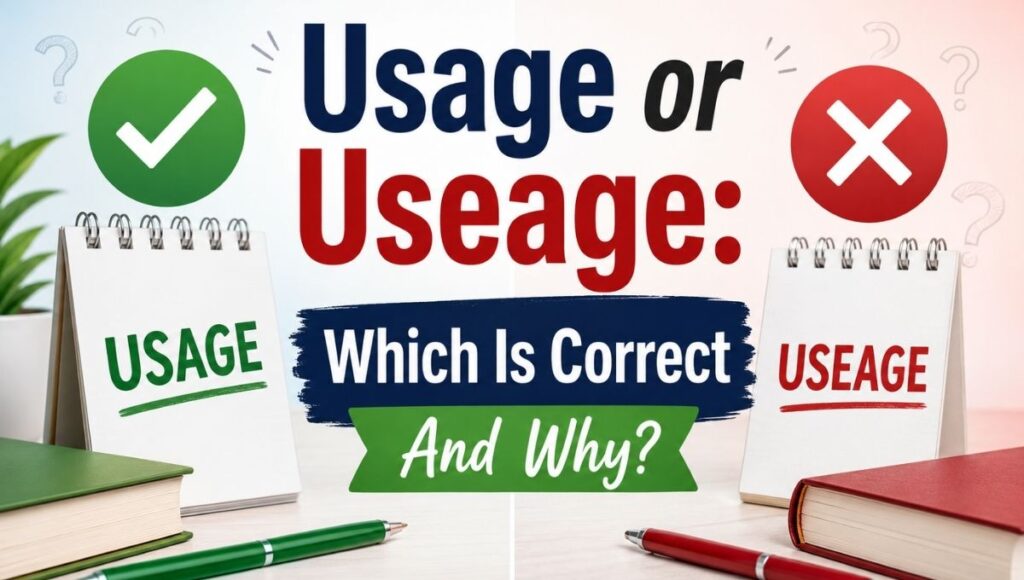
The good news is simple: “usage” is the correct spelling. “Useage” is a misspelling and shouldn’t appear in formal or informal writing.
In this guide, you’ll learn the difference between Usage or Useage, why the confusion happens, how to remember the correct spelling, and how to use usage confidently in everyday conversations, emails, academic papers, and business writing.
Usage or Useage: Which Is Correct?
The correct spelling is usage.
The spelling useage is incorrect and isn’t recognized as a standard English word.
Here’s a quick comparison:
| Word | Correct? | Meaning |
|---|---|---|
| Usage | ✅ Yes | The way something is used or the customary use of a word, object, or service. |
| Useage | ❌ No | Incorrect spelling of usage. |
Whenever you’re writing in English, always choose usage.
What Does “Usage” Mean?
The word usage refers to the way something is used or accepted practice within a language, profession, or activity.
Depending on the context, it can describe:
- The manner in which something is used
- Language conventions
- Consumption or frequency of use
- Established customs or practices
Examples
- Internet usage has increased dramatically over the last decade.
- The manual explains the proper usage of the equipment.
- The dictionary includes notes on common word usage.
- Daily water usage should be monitored during drought conditions.
In each example, usage describes either how something is used or how often it’s used.
Why Do People Write “Useage”?
The mistake usually happens because people mentally combine the words use and -age.
Since many English words retain the silent “e” before certain endings, it’s easy to assume useage follows the same rule.
It doesn’t.
Instead, English removes the final e before adding -age, giving us:
- Use → Usage ✅
- Use → Useage ❌
That’s simply the accepted spelling in modern English.
Why “Usage” Is the Correct Spelling
English spelling often follows historical development rather than strict pronunciation.
The word usage comes from older forms of French and Latin, eventually entering English without the extra e. Over time, dictionaries standardized usage as the only accepted spelling.
Today, every major dictionary recognizes usage and rejects useage.
Easy Trick to Remember the Correct Spelling
A simple memory trick can save you from making this mistake.
Think of these pairs:
- Marriage ✅
- Package ✅
- Message ✅
- Usage ✅
Notice that usage follows the same pattern. There’s no extra “e” after the letter s.
Another easy reminder:
If you’re talking about how something is used, the correct word is always “usage.”
Common Types of Usage
The word appears in many situations. Here are some of the most common.
Language Usage
Language usage refers to how words, grammar, or expressions are commonly used.
Examples:
- Proper usage improves your writing.
- Teachers often discuss grammar and word usage.
- Modern English usage changes over time.
Technology Usage
Technology companies frequently measure usage to understand customer behavior.
Examples:
- Screen usage increased during remote work.
- Monthly data usage exceeded the plan limit.
- App usage dropped after the update.
Utility Usage
Many households monitor utility usage.
Examples:
- Electricity usage was higher this month.
- Water usage decreased after repairing the leak.
- Gas usage peaks during winter.
Business Usage
Companies analyze product usage to improve customer experiences.
Examples:
- Customer usage reports reveal buying habits.
- Software usage helps developers identify popular features.
- Employee usage of the new platform exceeded expectations.
Examples of “Usage” in Everyday Sentences
Here are several natural examples.
- The report shows higher mobile phone usage among teenagers.
- Correct usage of punctuation makes writing easier to read.
- The software tracks employee usage throughout the day.
- Fuel usage increases during long road trips.
- The professor explained the historical usage of the phrase.
- Water usage restrictions begin next Monday.
- Internet usage reached a record high this year.
- Proper tool usage reduces workplace accidents.
Incorrect Examples Using “Useage”
These sentences contain the wrong spelling.
❌ My monthly internet useage is very high.
✅ My monthly internet usage is very high.
❌ The teacher corrected my word useage.
✅ The teacher corrected my word usage.
❌ Please reduce your electricity useage.
✅ Please reduce your electricity usage.
Whenever you see useage, replace it with usage.
Usage or Useage in Professional Writing
Professional documents demand accurate spelling. A single spelling mistake can distract readers and reduce credibility.
Always write:
- Software usage
- Equipment usage
- Employee usage
- Data usage
- Language usage
Never write useage in reports, resumes, proposals, or presentations.
Email Example Using “Usage”
Imagine a project manager reminding employees about software policies.
Subject: Software Usage Guidelines
Hi Olivia,
Our monthly review showed an increase in software usage across several departments. Please make sure everyone follows the updated company guidelines when accessing licensed applications.
If your team has questions about acceptable usage, feel free to contact the IT department.
Thank you,
Nathan Brooks
Notice that usage fits naturally throughout the email.
Workplace Conversation Example
Emma: Have you checked our printer usage report?
Daniel: Yes. Color printing increased by nearly 40% last month.
Emma: We should remind everyone to print only when necessary.
Daniel: That’s a good idea. Lower paper usage will also reduce costs.
Classroom Example
A teacher explains the difference to students.
Teacher: Today we’ll discuss proper word usage.
Student: Is “useage” ever correct?
Teacher: No. The only accepted spelling is usage.
Student: That makes remembering it much easier.
Customer Support Example
Customer: Why is my data almost gone?
Support Agent: Your account shows unusually high data usage during the past week.
Customer: That explains it. I’ll connect to Wi-Fi more often.
Common Expressions with “Usage”
You’ll often see usage paired with other words.
Some examples include:
- Internet usage
- Data usage
- Energy usage
- Water usage
- Language usage
- Software usage
- Mobile usage
- Equipment usage
- Battery usage
- Resource usage
These combinations appear regularly in business reports, technical documentation, education, and daily conversations.
Tips to Avoid This Spelling Mistake
If you frequently confuse Usage or Useage, these habits can help.
- Remember that dictionaries only recognize “usage.”
- Spell-check can catch “useage” instantly.
- Read your writing before sending emails or reports.
- Practice writing the correct spelling several times.
- Associate “usage” with common phrases like “data usage” or “language usage.”
The more often you use the correct spelling, the more natural it becomes.
Frequently Asked Questions
Is “useage” ever correct?
No. Useage is always considered a spelling mistake.
Why do people spell it “useage”?
People often assume the final e from use remains when adding -age. English doesn’t follow that pattern for this word.
Is “usage” used in American and British English?
Yes. Usage is the standard spelling in both American English and British English.
What does “language usage” mean?
It refers to how words, grammar, and expressions are commonly or correctly used within a language.
Can spell-check detect “useage”?
Most modern grammar and spell-check tools automatically flag useage as incorrect and suggest usage instead.
Final Thoughts on Usage or Useage
When comparing Usage or Useage, the answer is clear. Usage is the only correct spelling, while useage is simply a common misspelling.
Although the extra “e” may seem logical at first glance, English spelling follows established conventions rather than pronunciation alone. Once you remember that usage drops the silent e, the correct spelling becomes much easier to recall.
Whether you’re writing an email, preparing a business report, completing a school assignment, or posting online, choosing usage helps your writing look polished and professional. Keep this simple rule in mind, and you’ll never have to second-guess the spelling again.