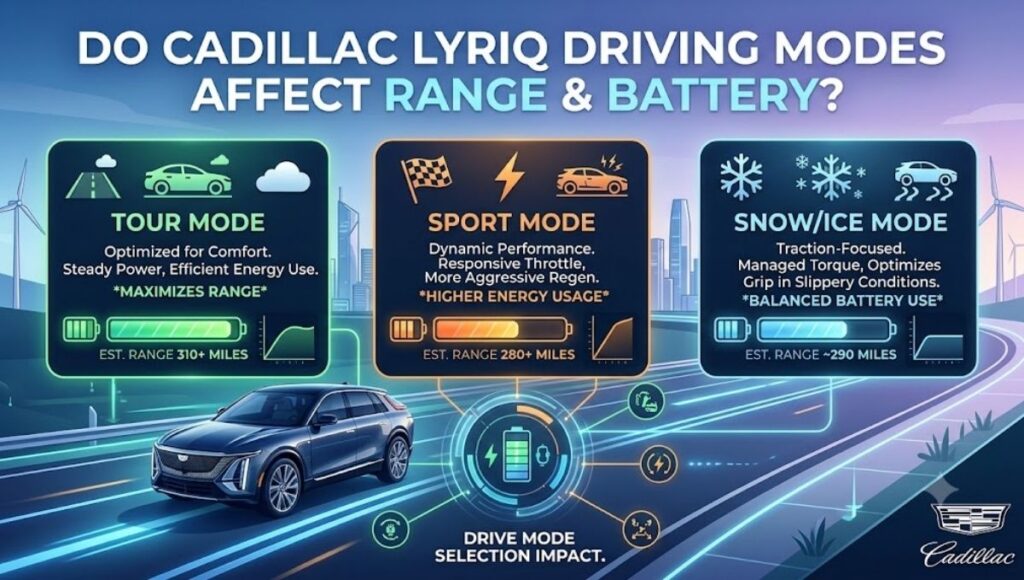
If you’ve spent any time behind the wheel of a Lyriq, you’ve probably noticed the little mode selector on the touchscreen and wondered what it’s actually doing. Is it just changing how the pedal feels, or is it quietly eating into your range every time you tap into Sport? It’s a fair question, and it deserves a straight answer instead of vague marketing language.
So let’s settle it: do the driving modes in Cadillac Lyriq offer different ranges or battery usages? Yes, they do. But not in the way most people assume. Your battery doesn’t shrink or grow depending on which mode you pick. What changes is how efficiently that battery gets used, and that difference is real enough to matter on a road trip.
The Short Answer
Here’s the deal in plain terms. Every Cadillac Lyriq, regardless of trim, runs the same 102 kWh Ultium battery pack. Selecting Tour, Sport, Snow/Ice, or My Mode doesn’t add or remove a single kilowatt-hour of capacity. What it does change is throttle response, regenerative braking behavior, and how eagerly the motors draw power.
That software-level difference translates into a real-world range spread. Owners commonly report somewhere in the range of 10 to 20 percent less range in Sport Mode compared to Tour Mode, and in some cases the gap widens to 50 miles or more depending on how aggressively you drive. That’s not a rounding error. If you’re planning a long trip, it’s worth knowing before you leave the driveway.
What Driving Modes Actually Control
It helps to understand what’s happening under the hood, so to speak, since there isn’t actually a mechanical change happening at all. Each mode adjusts a handful of software parameters:
- Throttle mapping — how quickly torque gets delivered when you press the accelerator
- Regenerative braking strength — how aggressively the car recaptures energy when you lift off the pedal
- Steering weight — how much resistance you feel turning the wheel
- Suspension and damper behavior — on trims equipped with adaptive suspension
- Traction and stability thresholds — how quickly the system intervenes on slippery surfaces
None of these touch the battery cells themselves. Think of it like adjusting the settings on a smartphone. Turning up screen brightness or running a demanding app doesn’t change your phone’s battery size, but it absolutely changes how fast that battery drains. The Lyriq works the same way.
Cadillac’s Actual Mode Lineup
According to the Lyriq’s owner’s manual, the vehicle offers four selectable modes: Tour, Sport, Snow/Ice, and My Mode. Availability and exact tuning can vary slightly by trim and equipment level, so a base Luxury trim and a performance-oriented V-Series model won’t feel identical even in the same mode. Still, the core behavior of each mode stays consistent across the lineup.
Tour Mode
Tour is the Lyriq’s default setting, and it’s tuned specifically for everyday efficiency. Acceleration builds smoothly rather than in a sudden rush, and regenerative braking is set to recover as much energy as possible. This is the mode that tracks closest to the EPA-estimated range figures, which makes it the obvious choice for commuting, errands, and long highway stretches where you’d rather stretch every mile than chase quick acceleration.
Sport Mode
Sport sharpens everything. The accelerator becomes more sensitive, torque arrives faster, and steering often firms up for a more engaged feel. That responsiveness is genuinely fun, but it comes at a cost. Quick acceleration demands a higher instantaneous current draw from the battery, and that’s where the efficiency hit comes from.
It’s worth being precise here: simply selecting Sport Mode doesn’t automatically torch your range. If you drive gently even in Sport, the difference shrinks. The mode just makes it easier to drive aggressively, and most people end up doing exactly that once the throttle feels sharper.
“The extra performance usually comes at the cost of higher energy consumption — but your driving style still has the biggest impact on the outcome.”
Snow/Ice Mode
Snow/Ice mode isn’t designed with efficiency in mind at all. Its entire job is traction and stability. Power delivery is smoothed out and delayed slightly so the wheels don’t spin on slick surfaces, and stability control intervenes earlier than it would in Tour or Sport.
Here’s something most guides get wrong: the range drop people notice in winter usually has very little to do with Snow/Ice Mode itself. It’s mostly caused by cold-weather battery conditioning and cabin heating, both of which pull energy regardless of which drive mode you’ve selected. Snow/Ice Mode’s own efficiency cost is minor by comparison.
My Mode
My Mode is the customizable option. It lets you independently dial in throttle sensitivity, steering weight, and regen braking strength to build a personal blend of the other three profiles. A driver who wants Sport-level throttle response but Tour-level regen recovery can build exactly that combination.
Official EPA Range vs. What Owners Actually See
Cadillac’s official range figures are worth knowing in detail, because there’s a genuinely interesting wrinkle in how they’re calculated.
| Configuration | Onboard Charger | EPA-Estimated Range |
|---|---|---|
| RWD, single motor | 11.5 kW standard | 326 miles |
| AWD, dual motor | 11.5 kW standard | 319 miles |
| AWD, dual motor | 19.2 kW optional | 303 miles |
That last row surprises a lot of people. Choosing the faster 19.2 kW onboard charger on an AWD Lyriq actually lowers the official EPA range by 16 miles, or about 5 percent. Cadillac has explained that trims equipped with the faster charger tend to carry slightly more weight from their standard equipment, and that added weight factors directly into how the EPA calculates range. It’s not the charger itself draining the battery faster; it’s the trim-level weight difference tied to it.
Real-world numbers tend to track reasonably close to these official figures, especially for RWD models. Owners commonly report landing within 5 to 10 percent of the 326-mile RWD rating in mild weather with moderate driving. AWD Lyriqs tend to run a bit lower in practice, often somewhere in the 250 to 290 mile range depending on speed, temperature, and how heavy a foot is behind the wheel. Sustained highway speeds of 75 to 80 mph will pull any EV, Lyriq included, below its EPA number by 20 percent or more, since the EPA test cycle blends city and highway driving at more moderate speeds.
Regenerative Braking’s Role in the Mode Difference
Regenerative braking deserves its own spotlight here, because it’s arguably a bigger factor in the range difference than throttle mapping alone. Every time you lift off the accelerator, the Lyriq’s motors act as generators, feeding energy back into the battery instead of letting it dissipate as heat through the brakes.
Tour Mode maximizes this recovery, which is a major reason it delivers the best real-world efficiency in stop-and-go traffic. Sport Mode softens the regen slightly, prioritizing a more engaging pedal feel over maximum recovery. One-pedal driving, available across modes, amplifies this effect further, and owners often report a 5 to 10 percent efficiency gain in city driving simply by leaning on it consistently.
Climate Control: The Factor That Often Outweighs Mode Choice
Here’s a fact worth sitting with: climate control frequently has a bigger impact on range than your drive mode selection does. Heating or cooling the cabin, along with conditioning the battery pack in cold weather, draws a substantial amount of energy independent of whatever mode you’ve selected.
A practical tip that actually moves the needle: seat heaters and the heated steering wheel use dramatically less energy than running the full cabin HVAC system. On a cold morning, warming yourself directly rather than blasting the cabin can meaningfully extend your range, regardless of which drive mode you’re in.
AWD vs. RWD — Does Drivetrain Change How Modes Behave?
The Lyriq’s drivetrain choice shapes how noticeable the mode differences feel. The single-motor RWD version is inherently more efficient, since there’s only one motor to manage and less overall drivetrain complexity. The dual-motor AWD version adds a front motor for stronger traction and quicker acceleration, but that comes with added weight and more energy draw when both motors are actively working.
In practice, this means the efficiency gap between Tour and Sport tends to be somewhat wider on AWD models, since the dual-motor setup has more performance capacity to lean on in Sport Mode. RWD owners generally see a smaller, though still noticeable, difference between modes.
Driving Habits Still Beat Mode Selection
It’s worth repeating this point plainly, because it’s the single most useful takeaway in this entire discussion: your driving habits matter more than your mode selection. Smooth acceleration, moderate speeds, proper tire pressure, and consistent use of regenerative braking will do more for your range than switching between Tour, Sport, or Snow/Ice ever will on their own.
A calm driver in Sport Mode can easily out-range an aggressive driver in Tour Mode. The mode sets the ceiling for how responsive the car can feel; your right foot decides how much of that responsiveness you actually use.
Practical Takeaways for Long-Distance Trips
For anyone planning a longer drive, a simple combination works well: Tour Mode paired with one-pedal driving delivers the closest match to the EPA sticker number and the most predictable range on the road. AWD owners should set expectations a bit more conservatively, especially at sustained highway speeds, since the extra motor and weight naturally pull the real-world number below the RWD figure.
Final Answer
So, one more time, plainly: do the driving modes in Cadillac Lyriq offer different ranges or battery usages? Yes, clearly and measurably, though the battery capacity itself never budges. Tour Mode stretches your range furthest, Sport Mode trades some of that range for a punchier feel, and Snow/Ice Mode prioritizes control over efficiency when the roads get slick. Understanding that distinction turns a confusing dashboard toggle into something you can actually use to your advantage.
FAQs
Does selecting Sport Mode drain the battery just by itself?
No. Sport Mode makes aggressive acceleration easier and more tempting, but it doesn’t consume extra energy while you’re driving gently. The range hit comes from how you use the mode, not the mode existing on its own.
How much range do I actually lose in Snow/Ice Mode?
Typically very little from the mode itself. Most of the winter range drop comes from cold-weather battery conditioning and cabin heating rather than Snow/Ice Mode’s throttle tuning.
Does My Mode help or hurt efficiency?
It depends entirely on how you configure it. Set throttle sensitivity low and regen high, and it can match or beat Tour Mode’s efficiency. Push it toward Sport-like settings, and it behaves accordingly.
Why does the AWD Lyriq have two different EPA range numbers?
The AWD version with the optional 19.2 kW onboard charger is rated at 303 miles versus 319 miles with the standard 11.5 kW charger. Cadillac attributes this to the slightly heavier equipment on trims that offer the faster charger, which factors into the EPA’s range calculation.
Is Tour Mode always the best choice?
For maximizing range, yes. But if you value quicker acceleration and don’t mind sacrificing some efficiency, Sport Mode remains a perfectly reasonable choice for daily driving, just with the understanding that your range will run a bit shorter.