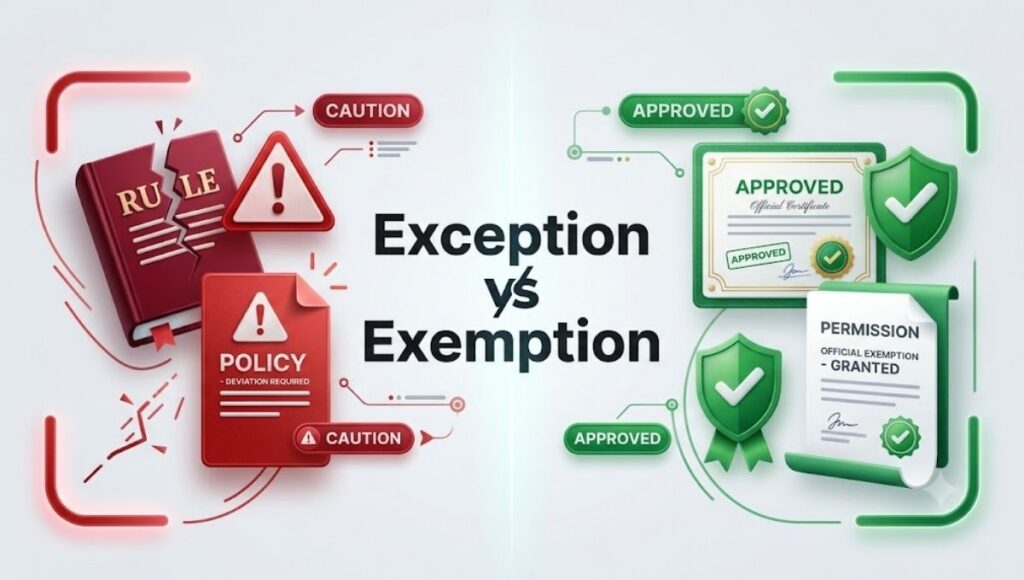
Many people use exception and exemption as if they mean the same thing. At first glance, the words seem closely related because both involve situations where a rule does not apply in the usual way. However, they serve different purposes and appear in different contexts.
Understanding the Exception vs Exemption distinction can improve your English vocabulary, strengthen your professional writing, and help you communicate more accurately in legal, academic, and workplace settings.
Whether you’re drafting company policies, writing an email, studying English grammar, or reviewing government regulations, knowing the difference between these terms can prevent confusion and misunderstandings.
This comprehensive guide breaks down the meanings, usage, examples, and practical applications of both words in a clear and easy-to-follow format.
What Is an Exception?
Let’s start with the exception meaning.
An exception is a person, thing, or situation that does not follow a general rule. In other words, it is an excluded case within a broader rule or pattern.
Think of it as a special circumstance that stands apart from the norm.
Simple Definition
Exception = Something that is excluded from a rule or statement.
Examples of Exception
- Everyone must wear a uniform, with the exception of visiting speakers.
- All employees work on Fridays except those granted a special exception.
- The store accepts returns within 30 days without exception.
In each case, the rule still exists. One particular situation simply falls outside it.
Exception in a Sentence
Here are a few practical examples:
- Sarah enjoys all vegetables with the exception of spinach.
- The office remains open every holiday with one exception.
- The company policy applies to everyone except senior executives.
These examples highlight the core idea behind an exception: a specific case that differs from the general rule.
What Is an Exemption?
Now let’s examine the exemption meaning.
An exemption refers to official permission that releases someone from a requirement, duty, obligation, or rule.
Unlike an exception, an exemption is often granted by an authority.
Simple Definition
Exemption = Freedom from an obligation or requirement because permission has been granted.
Examples of Exemption
- Students with qualifying circumstances received an exam exemption.
- Certain nonprofit organizations qualify for tax exemption status.
- Employees with documented health conditions may receive a medical exemption.
In these situations, a person or organization is formally relieved of an obligation.
Exemption in a Sentence
- The charity applied for a tax exemption.
- James received a fee exemption due to financial hardship.
- The employee was granted a medical exemption from travel requirements.
The key concept is that an exemption usually involves a release from obligation.
Exception vs Exemption Difference: Quick Comparison
The easiest way to understand the exception vs exemption difference is to focus on what happens to the rule.
| Feature | Exception | Exemption |
|---|---|---|
| Meaning | A case excluded from a rule | Permission to be free from a rule |
| Focus | The rule has a special case | The person is released from obligation |
| Requires Approval? | Not always | Usually yes |
| Common Contexts | Grammar, policies, rules | Taxes, laws, education, healthcare |
| Example | A policy exception | A tax exemption |
| Related Words | Except, exceptional | Exempt, waiver |
This distinction makes exception and exemption explained much easier to remember.
Exception vs Exemption Grammar
When discussing exception vs exemption grammar, the difference becomes even clearer.
Exception as a Noun
Exception identifies something that does not fit the rule.
Examples:
- Every candidate passed with one exception.
- There is no exception to the deadline.
Exemption as a Noun
Exemption refers to the act of being excused from a requirement.
Examples:
- She requested an exemption from the training program.
- The organization obtained a tax exemption.
Related Forms
| Word | Type | Meaning |
| Exception | Noun | An excluded case |
| Exceptional | Adjective | Unusual or outstanding |
| Except | Preposition/Verb | Excluding |
| Exemption | Noun | Freedom from obligation |
| Exempt | Adjective/Verb | Free from a requirement |
Understanding these forms strengthens your English grammar and overall writing skills.
When to Use Exception
Many writers struggle with when to use exception.
Use exception when discussing:
- An unusual case
- A departure from a rule
- Something excluded from a general statement
- A specific circumstance that does not fit a pattern
Examples
- Every team member attended except Michael.
- The dress code applies to everyone with one exception.
- Late submissions are rejected without exception.
A helpful memory trick is this:
An exception points to the rule that still exists.
When to Use Exemption
Knowing when to use exemption is equally important.
Use exemption when discussing:
- Official permission
- Release from obligations
- Legal or regulatory relief
- Authorized exclusions
Examples
- The student received an exam exemption.
- The charity qualified for a tax exemption.
- The employee requested a medical exemption.
An easy way to remember this is:
An exemption frees someone from a responsibility.
Exception vs Exemption Examples in Everyday Life
Looking at real-world situations helps clarify the distinction.
School Scenario
A school requires all students to take a final exam.
Exception: A special exchange student program is excluded from the requirement.
Exemption: A student with qualifying credits receives an exam exemption.
Workplace Scenario
A company requires employees to attend weekly meetings.
Exception: Remote contractors are listed as an exception in the policy.
Exemption: An employee receives an exemption due to medical circumstances.
Government Scenario
A city requires business permits.
Exception: Temporary nonprofit events are treated as exceptions.
Exemption: Qualified charitable organizations receive a permit fee exemption.
These practical exception vs exemption examples demonstrate how differently the words function.
Exception vs Exemption in Workplace Policies
The distinction becomes especially important in exception vs exemption in workplace settings.
HR teams frequently use these terms when creating workplace policies, ensuring compliance, and developing policy drafting guidelines.
Policy Exception
A policy exception occurs when a specific situation falls outside a standard rule.
Example:
A company requires three days of office attendance. A temporary project team may be granted an exception because they work on-site with a client.
Policy Exemption
An exemption formally releases an employee from a requirement.
Example:
An employee with documented medical needs may receive an exemption from travel obligations.
In business communication, using the wrong term could create confusion about whether someone is merely an unusual case or officially excused from a requirement.
Exception vs Exemption in Law
The distinction is even more significant in exception vs exemption in law.
Within legal terminology, the two words carry specific meanings.
Legal Exception
A legal exception identifies circumstances where a law or rule does not apply.
Example:
A regulation may prohibit certain activities except in emergency situations.
Legal Exemption
A legal exemption grants protection or relief from legal requirements.
Example:
Certain organizations may qualify for tax exemption under government regulations.
Because legal documents require precision, lawyers and policymakers carefully distinguish between these terms in legal writing.
Email Example Using Exception
Here is a professional example showing the correct usage of exception.
Email Example
Subject: Approval of Policy Exception
Dear Olivia,
After reviewing your request, management has approved a temporary exception to the standard travel policy.
This exception will remain in effect through September 30 while your project assignment continues.
Please note that all other policy requirements remain unchanged.
Thank you,
Ethan Parker
Operations Manager
In this example, the rule still exists. A specific situation receives special treatment.
Email Example Using Exemption
Now let’s look at an example involving an exemption.
Email Example
Subject: Medical Exemption Approval
Dear Mason,
Your request for a medical exemption from mandatory travel requirements has been approved.
Based on the documentation provided, you are exempt from business travel obligations until further review.
Please contact Human Resources if you have any questions.
Best regards,
Sophia Bennett
Human Resources Director
Notice how the employee receives a formal release from obligation.
Common Mistakes People Make
Because these words appear in similar situations, writers often mix them up.
Incorrect
- The company granted me an exception from paying taxes.
Better
- The company granted me a tax exemption.
Incorrect
- A medical exemption was listed as an exception in the policy.
Better
- The policy includes an exception for emergency situations.
- Employees may apply for a medical exemption.
This is why Exception vs Exemption remains one of the most important pairs of commonly confused words in professional communication.
Quick Memory Trick
Here’s a simple trick to remember the difference:
Exception
Think:
“An exception is an unusual case.”
The rule remains intact.
Exemption
Think:
“An exemption excuses someone.”
The obligation is removed.
If someone receives official permission to avoid a requirement, choose exemption.
If a situation simply falls outside the rule, choose exception.
Conclusion
Choosing between exception vs exemption matters because the two words communicate very different things. An exception is simply an excluded case, while an exemption is a formal release from a rule or obligation.
Understanding this distinction helps you write clearly, avoid legal misunderstandings, and maintain professional communication.
If you want precise, authoritative grammar explanations like this, explore more of our advanced language guides.