You’re mid-match. Your reflexes are sharp, your aim is on point, and then… nothing. A half-second of dead air where your input just doesn’t register. That gap is what breaks games, and more often than not, it’s not you. It’s the connection.
Connectivity HSSGamepad issues rank among the most common (and most misunderstood) complaints among gamers. People blame the game, blame their skill, or just blame “bad luck.” But wireless controllers run on physics and radio signals, not luck. Once you understand what’s actually happening between your thumbs and your screen, most problems stop being mysterious and start being fixable.
This guide breaks it all down: what connectivity really means for a gamepad, why it becomes unstable, and exactly how to fix it. No vague advice. Just the real mechanics and real solutions.
What Connectivity HSSGamepad Really Means in Real Gaming
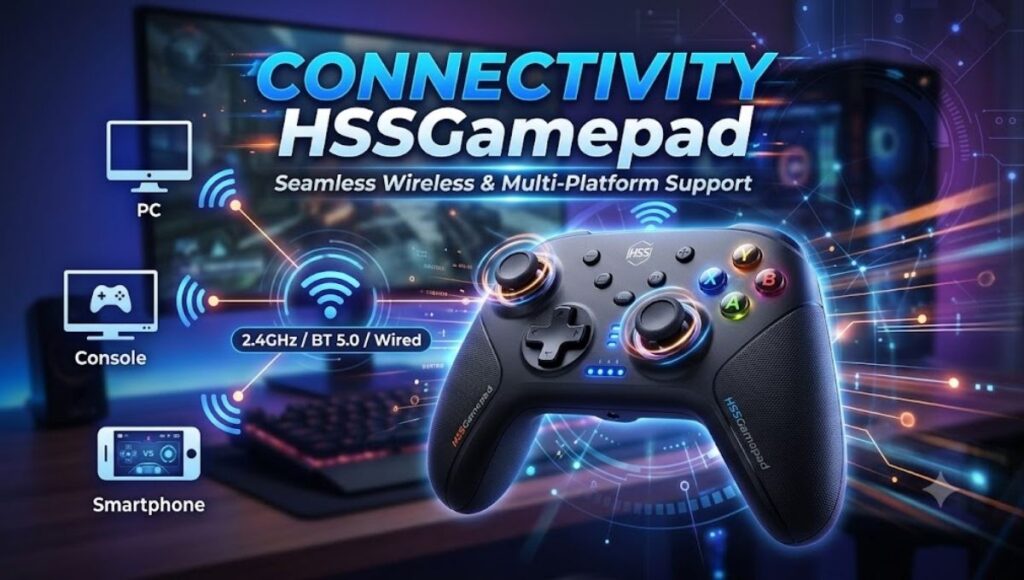
At its core, gamepad connectivity is about how your controller’s inputs get from your hands to your device, and how fast and reliably that happens. There are three real methods in use today:
- Bluetooth – A wireless protocol that pairs directly with your phone, tablet, PC, or TV without extra hardware.
- 2.4GHz RF (dongle-based) – A dedicated wireless signal sent to a small USB receiver, bypassing your device’s built-in Bluetooth stack entirely.
- Wired USB – A direct physical connection with no radio signal involved at all.
Each one sends the exact same kind of data: button states, stick positions, trigger pressure. What differs is how that data travels and how much delay gets added along the way. That delay is called latency, and it’s the single biggest factor separating a controller that “feels right” from one that feels laggy.
Understanding Connectivity HSSGamepad setups means understanding that your controller isn’t just “on” or “off.” It’s constantly polling, sending tiny data packets dozens of times per second, and any interruption in that stream shows up as a stutter, a skipped input, or a full disconnect.
Why Stable Connectivity Matters More Than You Think
A shaky connection doesn’t just mean occasional disconnects. It changes how the game feels, even when the controller technically still works.
Here’s the distinction most people miss: lag and disconnection are two different problems.
- Lag is a delay between your input and the game’s response — the controller stays connected, but it’s slow.
- Disconnection is a complete break in the signal — inputs simply stop registering for a moment or longer.
Both wreck your experience, but they come from different causes and need different fixes.
Real impact example
Picture a fighting game where a combo requires inputs within a tight window, say, a quarter of a second. A Bluetooth connection under interference can add 20–50 milliseconds of unpredictable delay on top of normal processing time. That doesn’t sound like much until you realize a quarter second is only 250 milliseconds total. Shave off a fifth of your input window randomly, and combos that should be consistent start dropping for no visible reason.
In a shooter, the same instability shows up as delayed aim adjustments or a shot that fires a beat too late. It’s not your reflexes. It’s packets arriving late or not at all.
How Connectivity HSSGamepad Works Behind the Scenes
Every wired or wireless controller works on a polling cycle. It samples the position of every stick, trigger, and button at a fixed rate, then sends that data to your device. The polling rate (measured in Hz, or times per second) determines the theoretical floor for how responsive a controller can be.
A wired USB connection typically polls at 125Hz to 1000Hz depending on the controller and driver, translating to roughly 1–8 milliseconds between updates. Bluetooth connections generally can’t match that ceiling because of how the protocol handles power-saving and packet scheduling.
Latency comparison in real gaming environments
| Connection Type | Typical Added Latency | Best Use Case |
|---|---|---|
| Wired USB | 1–8 ms | Competitive/esports play |
| 2.4GHz RF Dongle | 4–15 ms | PC and console gaming, low interference |
| Bluetooth (5.0+) | 15–40 ms | Casual play, mobile, TV streaming |
| Bluetooth (4.x or older) | 40–100+ ms | Backup use only, not recommended for fast-paced games |
These numbers shift depending on the specific controller, the receiving device, and environmental interference, but the pattern holds: wired beats RF, RF beats Bluetooth, and older Bluetooth versions lag noticeably behind newer ones.
Common Connectivity HSSGamepad Problems Gamers Face
Most complaints fall into a short list of repeat offenders.
Input Lag and Delay
You press a button and the action happens a beat late. This is almost always tied to connection type, interference, or an outdated driver rather than the controller being “broken.”
Random Disconnects
The controller drops entirely, sometimes for a split second, sometimes for several seconds. Usually tied to interference, battery voltage, or distance.
Pairing Conflicts
The controller connects to the wrong device, refuses to pair at all, or bounces between two paired devices it remembers.
Signal Interference
Other wireless devices — routers, microwaves, USB 3.0 hubs, even other controllers — compete for the same radio frequencies.
Stuttering or Input Freezing
Inputs get “stuck,” where the game keeps registering a button as held down even after you’ve released it, or the stick appears frozen mid-motion.
Why Your HSSGamepad Connection Becomes Unstable
Every one of those symptoms traces back to a handful of root causes.
Wireless Interference Everywhere
Bluetooth and 2.4GHz Wi-Fi both operate in the same crowded frequency band. Your router, smart home devices, neighboring Wi-Fi networks, and even a microwave in use can all create enough noise to disrupt a controller’s signal.
Weak Battery Performance
Wireless signal strength isn’t just about the antenna. Many controllers reduce transmission power as battery voltage drops, which weakens the signal well before the battery indicator shows “low.”
Distance Problems
Every wireless signal degrades with distance and obstruction. Walls, furniture, and even your own body between the controller and receiver can be enough to introduce dropouts, especially with Bluetooth’s typically shorter effective range.
Outdated Software or Firmware
Manufacturers regularly patch connectivity bugs, power management issues, and pairing conflicts. Skipping updates means running with known issues already fixed for other users.
Background Device Overload
Every Bluetooth device connected to your PC or console is competing for a slice of available bandwidth and scheduling time. A phone, headset, mouse, and controller all paired simultaneously can create enough congestion to cause noticeable lag.
How to Fix Connectivity HSSGamepad for Smooth Gaming
Start with the basics before jumping to advanced fixes — they solve the majority of cases.
Keep Your Controller Fully Charged
Charge fully before long sessions, and avoid letting the battery run down below 20% during competitive play, since signal strength often weakens before the low-battery warning appears.
Re-Pair the Controller Properly
Don’t just reconnect. Fully remove the device from your paired devices list, restart the controller, and pair it fresh. Half-remembered pairing profiles are a common source of intermittent drops.
Update Firmware and Drivers
Check the manufacturer’s app or website for the latest firmware, and make sure your device’s Bluetooth or USB drivers are current too. Both sides of the connection matter.
Reduce Wireless Interference
Move your router and controller further from other electronics, switch your Wi-Fi to a less congested channel, and keep other Bluetooth devices to a minimum while gaming.
Switch Connection Mode
If Bluetooth is unstable, try a 2.4GHz dongle if your controller supports one. If that’s still shaky, go wired. Isolating the connection type is the fastest way to identify whether the problem is the signal itself or something else entirely.
Advanced Fixes for Better Connectivity HSSGamepad Performance
If the basics don’t fully resolve it, these deeper fixes usually do.
Clear Pairing History
Beyond removing the device on the controller side, clear the paired device cache on your PC, phone, or console too. Lingering conflicting profiles can cause silent handshake failures.
Optimize System Power Settings
On Windows, disable USB selective suspend and turn off power-saving for Bluetooth adapters in Device Manager. These settings are designed to save battery but frequently throttle wireless peripherals mid-use.
Match Bluetooth Version Compatibility
A controller built for Bluetooth 5.0 paired with an older 4.0 receiver won’t get 5.0 performance; it’ll run at the lower version’s speed and range. Check both ends of the connection, not just the controller spec sheet.
Use Wired Mode for Competitive Gaming
For ranked matches, tournaments, or anything latency-sensitive, wired mode removes almost every variable discussed above. It’s the single most reliable fix available.
Optimize Physical Setup
Keep a clear line of sight between the controller and receiver, avoid placing the receiver behind a metal surface or monitor, and use a USB extension cable to move the receiver closer to you and further from interference sources like your PC tower.
Table: Common Problems vs Real Causes vs Fixes
| Symptom | Likely Cause | Fix |
|---|---|---|
| Random disconnects | 2.4GHz Wi-Fi interference | Change Wi-Fi channel, move devices apart |
| Delayed inputs | Bluetooth congestion or old firmware | Update firmware, reduce paired devices |
| Won’t pair at all | Corrupted pairing cache | Clear pairing history, re-pair fresh |
| Stick or button “stuck” | Signal dropout mid-poll | Switch to wired temporarily, check battery |
| Works close, fails at distance | Weak antenna or obstruction | Reposition receiver, remove obstacles |
| Fine solo, laggy with others connected | Bandwidth competition | Disconnect unused Bluetooth devices |
How Stable Connectivity Improves Gaming Performance
Once the connection is solid, the difference isn’t subtle. Combos land the way you intended. Aim tracks smoothly instead of jittering. Menu navigation stops feeling delayed. Competitive players in particular notice that a stable, low-latency connection makes their actual skill visible for the first time, since the controller stops introducing random variance into their inputs.
Stability also protects long-term equipment health. Controllers that constantly re-negotiate weak or dropped connections tend to drain battery faster and put more strain on internal wireless components than one holding a clean, steady signal.
Pro Tips to Maintain Long-Term Stability
- Update firmware every 1–2 months, or whenever your platform notifies you of an available patch.
- Keep a wired backup cable on hand, even if you primarily play wireless.
- Avoid charging and gaming simultaneously on cheap or damaged cables, since this can introduce power interference.
- Limit Bluetooth clutter — disconnect devices you’re not actively using during gaming sessions.
- Store the controller properly between sessions; extreme heat or cold can affect battery performance over time.
Why Gamers Misdiagnose Connectivity Problems
It’s easy to blame the wrong thing. A common pattern: someone experiences input lag, assumes the game itself is poorly optimized, and spends hours adjusting in-game sensitivity settings that never actually address the root cause. Meanwhile, the real issue is a crowded 2.4GHz environment or an outdated Bluetooth driver.
The fastest way to avoid this trap is to isolate variables. Test wired first. If the problem disappears, you’ve confirmed it’s connection-related, not game-related, and you can work backward from there.
Case Study: Fixing a Laggy HSSGamepad Setup
Problem:
A gamer reported consistent, unpredictable input delay while playing on PC via Bluetooth, despite a fully charged controller and no obvious hardware issues.
Investigation:
Testing revealed the delay only occurred when the gamer’s phone and wireless headset were also connected via Bluetooth at the same time. Switching to a wired connection eliminated the lag entirely, confirming the issue was connection-related rather than a game or hardware fault.
Fix applied:
The gamer disconnected the unused Bluetooth headset during gaming sessions, updated the controller’s firmware, and switched from Bluetooth to a 2.4GHz dongle for gaming specifically, reserving Bluetooth for casual, low-stakes use.
Result:
Input delay dropped to a level the gamer described as “instant” compared to before, and disconnects stopped entirely across multiple sessions.
What Competitive Players Say About Connectivity
Among competitive gaming communities, a common refrain is some version of: “Your reflexes only matter if the signal keeps up with them.” It’s a simple way of putting a real technical truth — no amount of skill compensates for a connection quietly adding delay or dropping inputs behind the scenes.
Frequently Asked Questions
Why does my HSSGamepad lag even when new?
A brand-new controller can still lag if it’s paired over Bluetooth in a congested wireless environment, running outdated firmware out of the box, or competing with several other paired devices. Newness doesn’t prevent interference or software issues.
Is wired always better than wireless?
For latency and consistency, yes — wired removes almost every variable that causes instability. For casual play where a few milliseconds don’t matter, a well-optimized wireless connection is perfectly fine.
Can Wi-Fi affect controller performance?
Yes. Bluetooth and 2.4GHz Wi-Fi share overlapping frequency space, and a busy home network can measurably degrade a wireless controller’s stability, especially in apartments or houses with many connected devices nearby.
How often should I update firmware?
Checking every month or two is a reasonable habit, and it’s worth checking immediately if you start noticing new connectivity symptoms that weren’t there before.
Final Thoughts: Build a Connection That Never Fails You
Good Connectivity HSSGamepad performance isn’t about luck or buying the most expensive controller on the shelf. It’s about understanding the handful of real variables — connection type, interference, firmware, and battery health — and managing them deliberately instead of guessing.
Start with the basics: charge properly, re-pair cleanly, update firmware, and reduce interference. If problems persist, isolate the variable by testing wired. Nine times out of ten, that single test tells you exactly where the real problem lives.
Get the connection right once, and you stop thinking about it. That’s the whole goal: a setup reliable enough that the only thing left to focus on is the game itself.